
 5°
5°  5 կմ/ժ


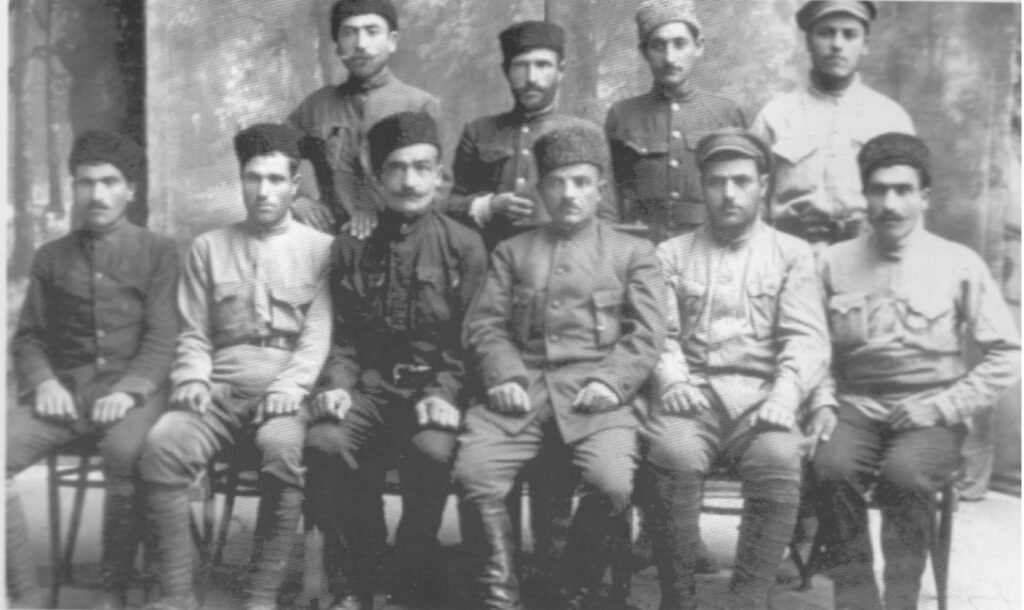
The history of Rind is rich in heroic episodes, but among them, one figure stands out, whose name became synonymous with incredible physical strength, innate military talent, and unreserved devotion to the homeland. We are speaking of the Dashnak fedayi Mher—the son of Mkrtich of Rind, grandson of Balin, and great-grandson of Melik-Safar.
As a member of the Vayots Dzor command group and a comrade-in-arms of Yapon and Andranik, Mher left his mark on the history of the national liberation struggle. However, beyond dry facts, the testimonies of his contemporaries are far more eloquent.
Below, I present exclusive memoirs about Mher, written by Arshaluys Astvatsatryan, the commander of the self-defense forces of the First Republic of Armenia and a prominent military figure. This material was published in the October 1949 issue of “Hayrenik” magazine.
The Natural-Born Warrior
Astvatsatryan remembers Mher as a unique phenomenon among the volunteer soldiers of Vayots Dzor, distinguished both by his spiritual qualities and his physical appearance. Comparing him to other famous fedayis of the time, such as the Aleksans of Erdapin or Khecho of Malishka, the author notes:
“Mher was something more. He was, if one may say so, a natural-born, indigenous warrior. He had acquired little from the outside, from his surroundings. Everything stemmed from his inner essence. I had the impression that he needed no explanations; from a single glance, he understood when, what, and how things should be done. Of such men, our villagers used to say: ‘Give him a thread, and he will understand the whole cloth.'”
Physical Strength and Modesty
Mher’s appearance left a formidable impression. Astvatsatryan writes that upon seeing him, the thought crossed his mind that the famous “Mher of Hunter Avo” was nothing compared to him.
“Even now, I cannot suppress a smile when I remember Mher’s petite and delicate wife, who, when looking at her husband, would tilt her head back just as one usually does when looking at the top of a tall tree. Tall and broad-shouldered, Mher was the embodiment of unbreakable physical force.”
Yet, this giant surprised everyone with his modesty. Unlike many who knew how to “value” themselves according to circumstances, Mher was the first in action, but outside of duty, he was an ordinary villager. The villagers adored him, considering him the pride of Rind.
The Guarantor of Rind’s Security
Rind was situated on the final line separating Armenian and Turkish villages and would be the first to come under attack in case of danger. Although the neighboring villages of Aghavnadzor and Arpa (Areni) were ready to help, for the people of Rind, Mher’s presence was the paramount guarantee.
However, in those days, Mher belonged neither to the villagers nor to himself; he was at the disposal of the local organization and was sent wherever his presence was deemed necessary.
“During the Armenian-Turkish clashes, Mher, all by himself, had the value of an entire squad in the eyes of his people. And when he was in the village, his fellow villagers were at ease. But when he was absent, Rind considered itself in danger.”
Even before the actual fighting began, the Armenian side had a severe shortage of weapons. In all of Vayots Dzor, there were only five state-issued rifles. To deter the enemy, local figures resorted to cunning, creating the illusion of large fedayi detachments.
“With local comrades, we were simply acting to impress the neighboring Turks… We had formed a horsemen group wearing yapunjis (felt cloaks) and tasseled papakhas, some armed with whatever rifles were at hand. Late in the evenings, they would gallop past the Turkish villages and vanish into the darkness…”
It worked. The next day, Turks would come to the Armenian villages to assure them of their “neighborly” intentions.
Transporting Weapons and the Dangerous Crossroads
Soon, the Vayots Dzor committee sent a man to Yerevan to bring weapons. They succeeded in obtaining rifles and ammunition. On the way back, when the group loaded with weapons had to pass through Turkish villages, a critical situation arose.
Astvatsatryan decided to ride ahead, reach Rind, and warn Mher so that he could come out to meet them and secure the passage of the weapons through the dangerous section.
“When I had approached the dangerous spot, I noticed the road forked. I realized one led to the Turkish village and the other to Rind… My horse solved the problem by confidently taking the path leading to the left.”
The horse was mistaken. Astvatsatryan rode straight toward the enemy village. His comrades shouted warnings from behind. At that moment, a Turkish youth spotted him. Astvatsatryan lied in Russian, claiming he was going to Keshish-kend (Yeghegnadzor) and had taken the wrong road, then galloped away toward Rind. The youth ran to his village to spread the news.
Upon reaching Rind, Astvatsatryan stopped in front of Mher’s house. Mher was home.
“He instantly understood what the matter was and, grabbing a huge club, flew out of the house. Another moment, and taking a few men with him, they rushed out of the village toward our group.”
Fortunately, the Armenian group had managed to cross the dangerous line, and the Turks were late. A verbal altercation began, which, however, ended with Mher’s appearance. The Turks, preparing to enter the fray, immediately sensed the seriousness of the moment and retreated when they saw Mher from afar. They knew Mher’s strength well.
“The verbal fight ended with the appearance of Mher. The Turks prudently turned back. We entrusted the weapons to Mher and continued our journey.”
Arshaluys Astvatsatryan concludes his memoirs with an assessment of Mher’s character, noting that Mher was about 20 years old at the time.
“Mher would have been twenty years old at that time. I have no doubt that whatever he was at the age of twenty, he remained the same upon entering his seventh decade—that is, with a simple and pure peasant soul and a great feeling toward his homeland, toward his nation… To imprison or punish men like Mher means to conspire against the homeland and the nation. The hand raised against Mher or those like him is not an Armenian hand.”