


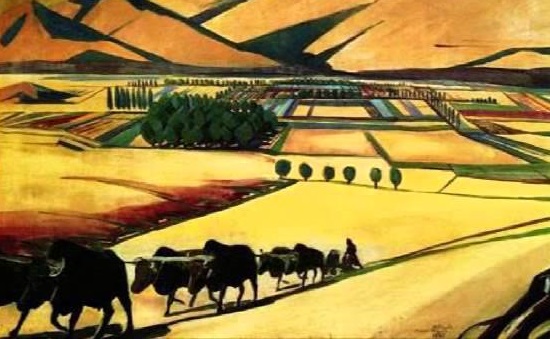
Before the mechanization and collectivization of agriculture, farming in the mountainous terrain of Vayots Dzor, specifically in Rind and its surrounding settlements, required a unique approach to work organization. Plowing was a crucial phase of community-social relations, centered around the machkal (plowman) and the primary draft power of the economy: the draft ox.
In the 19th century, the economic capacity and social status of a peasant household were largely determined by the number of draft animals. An adequate number of oxen ensured the depth and quality of plowing, which directly affected crop yields.
To plow the heavy and hard soils of Vayots Dzor, the traditional heavy wooden Armenian plow (guthan) was used. One or two oxen were not sufficient to tear the soil layer; often, 4 to 6 yokes (8 to 12 oxen) were required. Since a single family rarely owned such a number of animals, a clear system of mutual aid and cooperation developed in rural communities. Households pooled their draft power, forming a single common plow yoke, and took turns plowing each other’s land allotments.
The most economically vulnerable were those families deprived of oxen. The draft animal provided the food security of the household; its absence or illness resulted in land remaining uncultivated, which directly meant poor harvests and the accumulation of debt. This explains the peasant’s pronounced care for the animal: the ox was allocated the best part of the barn and quality fodder, even at the cost of limiting food for family members.
Division of Labor and Occupational Folklore
The division of labor during plowing was strictly regulated: the “machkal” controlled the handle of the plow (mach), adjusting the depth of the furrow, while the “hotaghs,” usually adolescents, controlled and drove the oxen forward with long switches.
This heavy, physically exhausting process was accompanied by specialized occupational folklore: the horovels. These texts were not only a tool to maintain the rhythm of work but also important ethnographic documents. An example is the work song “Yel, yel” (Rise, rise) recorded by Komitas:
The song reproduces a typical socio-psychological episode of plowing. It depicts the moment when the animal, exhausted under the heavy yoke, sinks into the furrow. Notably, the motif of violence is absent in the text: the machkal or hotagh tries to get the animal to its feet with nominal (Lachin, Maral) and encouraging calls. This testifies to the realization that the draft animal is not simply a working tool, but the primary guarantor of sustenance.
The concluding lines of the song clearly record the condensed regimen and massive time burden of agricultural work. Under conditions of limited agrotechnical deadlines, the peasant was forced to work from dawn until late at night.
Using the example of 19th-century Rind and Vayots Dzor, it becomes evident that plowing was a difficult but highly systematized economic process, where the food security and demographic stability of the entire community depended on the effective interaction of human labor, the working tool (the plow), and the draft animal.
