


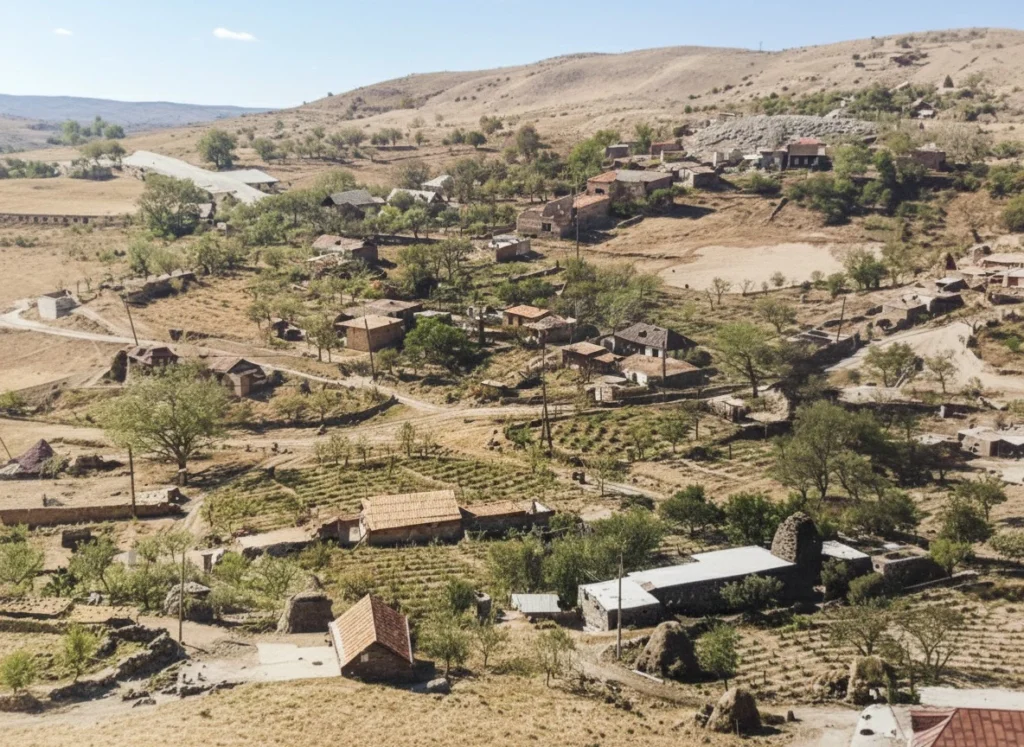
The true face of every settlement is visible not only in its stone monuments but also in the customs and rituals that have accompanied its people through the most important milestones of their lives for centuries. When studying the historical past of Rind village, wedding traditions hold a special place.
This article was written using materials from the valuable ethnographic journal “Vayots Dzor: Ethnography” published by ethnographer Yervand Lalayan in 1906, the parish registers of Rind village, and data from cameral censuses of various years. Oral memories of the elderly could not be sufficient in this case, as at best, they could only convey the mediated echoes of events that took place three generations ago. Below is an authentic picture of the family and wedding culture formed in Rind from the 19th century to the beginning of the 20th century.
Marriage Age and Selection
In the 19th century in Rind, girls were married mostly between the ages of 13 and 17, and boys between 16 and 35. Cases of earlier marriages were almost unrecorded, which had two main reasons: first, in the harsh mountainous geographical conditions, physical maturation was reached exactly at this age threshold. Second, unlike other regions of the Armenian Highlands, where underage girls were often married off to save them from the danger of falling into the harems of foreign tyrants (Turks or Sardars), a relatively freer and more protected atmosphere prevailed in Rind and Vayots Dzor in general. Nevertheless, by 19th-century standards, a girl who had reached the age of 18 was already considered an “old maid.”
Almost without exception, the husband was older than the wife, usually by 5 to 15 years. It was extremely rare for a widower to marry a teenage girl, or a widow to marry an unmarried young man.
In-law relationships were established exclusively with Armenians. Mostly, marriages were concluded within the village itself. In the case of inter-village ties, priority was given to the closest neighbor, Aghavnadzor, followed by Arpi (present-day Areni) and Khachik. There are also records of intermarriage with the village of Gnishik. The inhabitants of all these settlements were considered the indigenous people of Vayots Dzor—”old Armenians,” and their dialect was called “old Armenian” by the people.
Any relationship with people of other faiths was strictly condemned and censured not only by parents and the clergy but also by the entire community. A striking testimony to this intolerance is an incident in Khachik village, where a Kurd kidnapped Amirzada’s daughter and crossed into Turkish Armenia. The people of Khachik did not accept the disgrace: first, they killed one of the Kurd’s relatives, then crossed the border, found the kidnapper and the girl in Van, and killed them both.
The attitude of Rind’s residents towards other Armenians who migrated to Vayots Dzor in the 19th century is also noteworthy. The people of Rind avoided giving their daughters in marriage to the migrants, arguing that they “keep brides poorly, oppress and overwork them.” However, the reverse was perfectly acceptable: they gladly sought girls from the migrants, convinced that the bride would live a better and more content life in their home.
Matchmaking and Betrothal (Nshandreq)
In the past, the decision to marry was solely the monopoly of the parents. When making a choice, great attention was paid to genetics and upbringing: when choosing a girl, they looked at her mother, and for a boy, the father’s merits. A “virtuously raised” bride and a “true son of his father” groom were considered ideal. Only in the late 19th and early 20th centuries did the wishes of the young begin to be taken into account; sometimes a mother would secretly ask her son if he had a girl in his heart.
Although cases of bride kidnapping were recorded, the primary and accepted path was matchmaking. Before officially asking for the girl’s hand, intermediaries tried to prepare the ground and understand the family’s disposition. Then the boy’s paternal or maternal uncle (but never the father) would go to the girl’s house.
The proposal was made with traditional formulas: “We have come to ask for your daughter [name] for our son [name],” or more metaphorically, “We have come to take a spark from your lamp.” No matter how agreeable the girl’s parents were, they would not give their word immediately, maintaining the ritual of “going and coming.” Refusals were also polite: “We cannot give her this year, we are short on bread.” Notably, until final agreement, the girl’s family would not treat the matchmakers to anything (despite their renowned hospitality), as there was an unwritten rule: “If you give bread to the matchmaker, you must give your daughter too.”
Upon receiving agreement, the matchmakers took out the bottle of vodka they had brought, and the preliminary alliance was sealed. That same evening, the boy’s relatives (including women) came to the girl’s house. Here, the oldest man from the boy’s side officially asked for the girl’s hand from the elder of her family, receiving the awaited response: “Take her, may you see goodness.” Blessings and good wishes were spoken: “May God bless them, may God grant a good life, may every bachelor be worthy of this.” The boy’s side handed a silver ring and a headscarf to the bride’s mother. At this entire ceremony—the betrothal (Nshandreq)—neither the bride (who went to a relative’s house at that time) nor the groom was present.
Bargeah and Yeres-tesnuk (Seeing the Face)
Days after the betrothal, the boy’s parents gathered their relatives and the priest, and after a small feast, headed to the bride’s house. They did not go empty-handed: they brought fruits, food, a lamb or kid roasted in the tonir (khrov), a sugar loaf, and garments intended for the bride. This ritual was called Bargeah.
During the feast, the brought “khrov” was placed before the parish warden, who carved and distributed it to the guests. After dinner, a touching moment took place: the yeres-tesnuk. The bride, her face covered with the headscarf brought at the betrothal, approached the guests and kissed the priest’s hand. Relatives gave gifts during this time, which were publicly announced and handed to the bride’s father. The father had no right to spend these gifts; they were the bride’s property and were later given to her with her dowry.
Only after all this did the groom get the right to secretly visit his fiancée. At night, he went to his mother-in-law with fruits; she secretly received him, treated him to an omelet, and let him see the girl. Over time, this strictly secret meeting was replaced by the official “groom-calling” (phesakanch).
The betrothal period could last from six months to three years. During this time, on all major holidays (Candlemas, Lent, Palm Sunday, Easter, Ascension, Vardavar), the in-laws sent each other gifts called harsnepay or phesapay.
The Role of the Qavor (Godfather) and Pre-wedding Rituals
In Rind, the role of the Qavor was a sacred and unbreakable institution. The godfather was hereditary and could only be changed in one case: if there was no male heir in the godfather’s family. Even today, there are families in the village who have maintained their hereditary godfathers from generation to generation.
The days preceding the wedding were marked by unique ceremonies:
Shordzeveq (Dress Cutting): A few days before the wedding, the groom’s mother gathered the women, treated them, and then showed the fabric for the wedding dress. The fabric was entrusted to a “lucky” woman. She would put the scissors on the fabric but refuse to cut, complaining that the scissors were blunt until she received gifts from the groom’s mother and the other women. Using the same principle, a lucky “flour sifter” woman was chosen on Thursday.
On the day of Shordzeveq, the groom, along with the godfather and the priest, visited the mourning houses of the village. The priest read a prayer, the godfather distributed wine and offered words of comfort, and the groom officially invited the mourners to his wedding, asking them to come out of mourning.
Ginetap (Wine Pouring / Karasthapeq): On the Thursday evening preceding the wedding, men gathered at the groom’s house. A Maranapet (cellar master) was chosen, entrusted with managing the drinks and food, and a Tamada (toastmaster), who not only led the toasts but directed the entire ceremony.
The Wedding Proper
On Friday noon, at the tamada’s instruction, the “callers” roamed the streets accompanied by dhol and zurna, inviting the villagers to the wedding. Then the tamada asked the people for permission to slaughter the groom’s father’s ox. Interestingly, before any wedding action (slaughtering, sifting, mixing), they formally claimed it was not working out until they received gifts or money.
On Saturday morning, the dhol-zurna played the “Sahari” melody. They drank toasts to the in-laws, the king (groom) and queen (bride), and the shoshbis (the groom’s party). A red handkerchief was tied to the groom’s chest, and the bride-fetchers, dancing and firing guns, headed to the bride’s house. The groom’s parents stayed home.
At the bride’s house, where there was also a feast, only wine was served. The priest blessed the bride’s attire and collected money for the church (khachhambyur). While the bride was dressing, one of her relatives tied a green handkerchief to the groom’s chest: thus the groom became “red-green.” One of the elders from the boy’s side brought the bride out and stood her next to the groom. After the priest’s blessing, the people, strictly maintaining their formation (the godfather to the right of the king, the azab bashi / best man to the left, the bridesmaid to the right of the queen, the bride’s brother to the left), moved towards the church for the matrimonial crowning.
On Sunday, the newlyweds were taken to the groom’s house (this time accompanied by the king’s father). Upon entering the house, they passed under the godfather’s sword. The bride secluded herself in a room, where a little boy was sitting in her spot. For the child to give up the seat, the bride gifted him a pair of socks.
The days following the wedding had their strict regulations:
Monday (Khash day): Only men gathered at the groom’s house to eat khash.
Tuesday and Wednesday: On these days, the family was busy seeing off guests, returning the collected dishes to the village, and cleaning the house. During this whole time, the bride slept with her bridesmaid.
Wednesday evening: The priest was invited to untie the groom’s “red-green” with a blessing, after which the newlyweds entered the nuptial chamber. In the morning, they were served honey omelet and khavits.
Eight days later (Glukhlva – Head Washing): The bride’s mother came to her daughter’s new home with female relatives, bringing her remaining clothes, gata, halva, and gifts.
Every wedding ritual, song, and movement in Rind carried the wisdom coming from the depths of centuries, faith in the strength of the family, and unbreakable community solidarity. It is these traditions that forged the indomitable spirit and national character of the people of Vayots Dzor for centuries.
