

The settlement of the current Rind village dates back to 1966-1969, when the entire population was relocated from the village of Old Rind, located about 3 km to the northeast of the present-day settlement. According to archival documents, Old Rind was founded in the 1830s by seven families. These two settlements constitute a single historical, demographic, and logical entity. However, exploring the earlier historical layers, particularly the choice of the settlement’s location and the toponym “Rind,” requires a comprehensive source-based approach.
Demographic Picture and Self-Perception
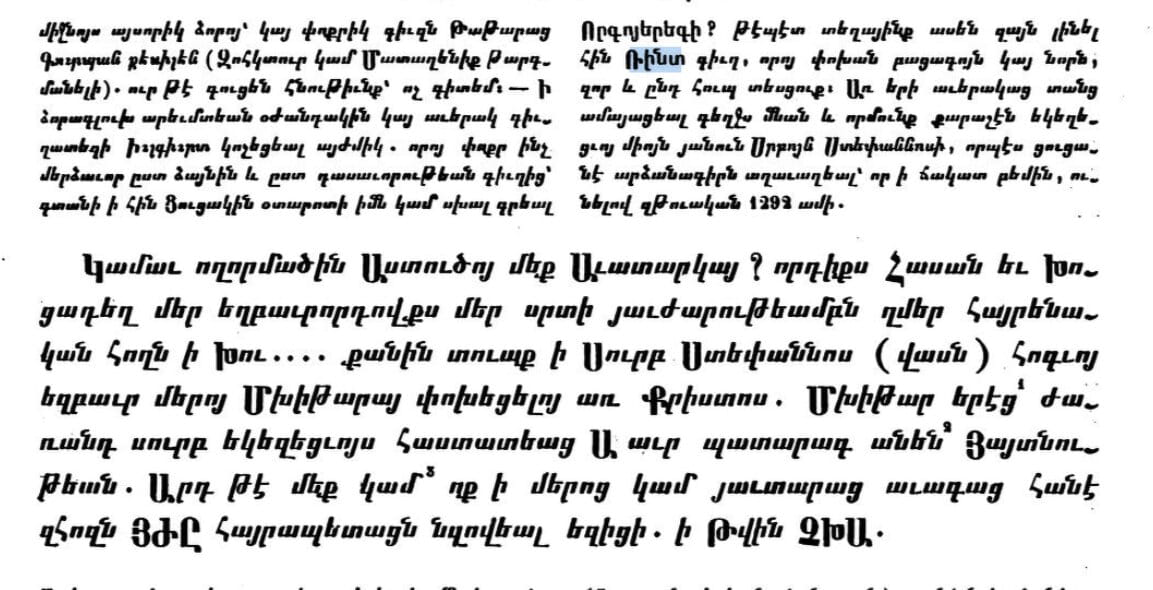
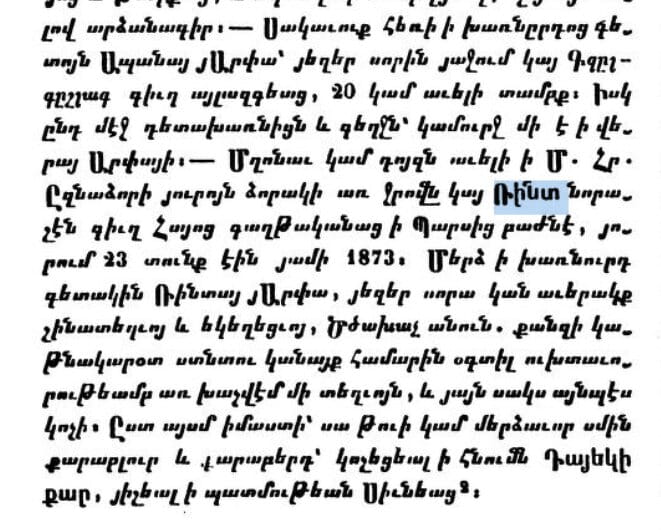
The vast majority of Rind’s resettlers are descendants of native Armenians. This explains their dialect (the middle dialect of Vayots Dzor) and ethnic self-perception. In the region, the inhabitants of Rind are traditionally called “old Armenians.” This term entered circulation at the beginning of the 19th century to distinguish the native inhabitants from the population that migrated from Parskahayk (Persian Armenia) following the Treaty of Turkmenchay, whom the locals called “new (taza) Armenians,” and their dialect “new Armenian.” Preliminary genealogical studies show that the families who founded Old Rind, being natives of Vayots Dzor and Nakhichevan, are not the direct descendants of the former inhabitants of Rind or its associated ancient settlement. Therefore, the main question remains: was a completely new settlement with a new name founded in the 1830s, or is it the successor of another historical settlement?
Source Testimonies (Orbelyan, Alishan, Lalayan, Kajberuni)
The question of identifying Rind and its preceding settlement has been discussed in 19th and 20th-century Armenian historiography and ethnography. Researchers Yervand Lalayan, Ghevond Alishan, and Gabriel Ter-Hovhannisyan (Kajberuni) adopted the 13th-century historian and Metropolitan of Syunik, Stepanos Orbelyan’s work “History of the Province of Sisakan” as their historical foundation.
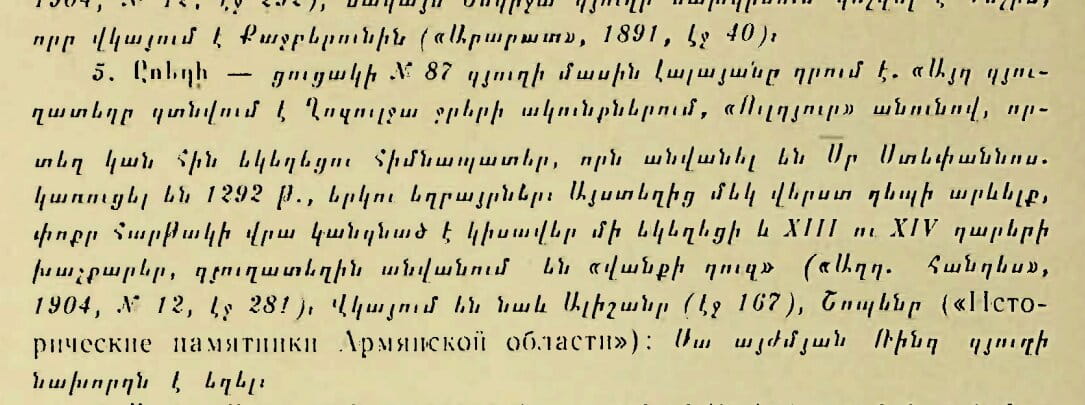
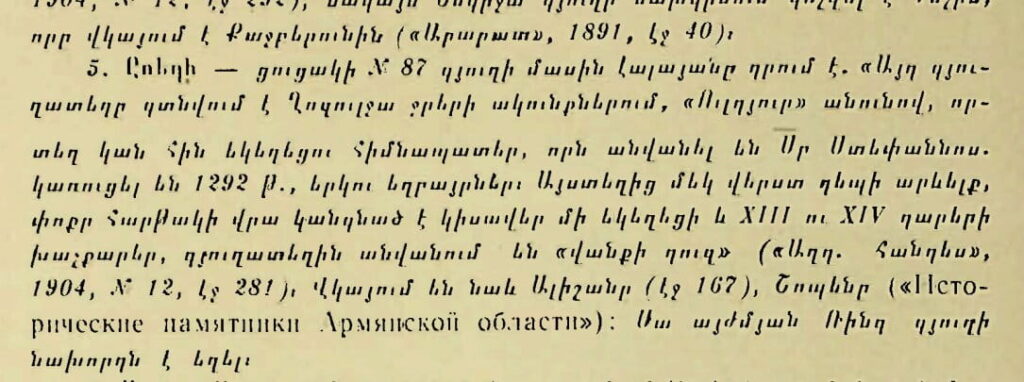
A. O. Khachatryan, in his 1974 article “On the Location of a Number of Historical Settlements in Vayots Dzor,” notes that the 87th village in Orbelyan’s tax list is Erredi. According to modern topography and ethnographic testimonies (specifically “Azgagrakan Handes” [Ethnographic Review], 1904, N12, p. 281), this village site is located at the sources of the Ghozollsha stream and is known by the name “Ulgyur.” The foundation walls of the St. Stepanos church (built in 1292) have been preserved here. To the east of it lies another ruined church and 13th-14th-century khachkars (in the “Vanki duz” area). This view is also supported by I. Chopin and Gh. Alishan, recording that this very site was the predecessor of Rind village.
The writer and traveler Kajberuni clearly records in his work “Travel Notes” (p. 127): “The village of Rind is not really the current one, but the ruin named Yulgyurd located to its northeast. The village of Rind might be the village of Erredi mentioned in Orbelyan’s list.”
Ghevond Alishan gives the following description in his work “Sisakan” (p. 167): “At the valley head of the western tributary stands a ruined village site now called Yulgyurt (present-day Ulgyur)… although the locals say it is the old village of Rint, instead of which stands the new one openly… Near the ruins of the deserted houses of this village remain the stone-built walls of the only church dedicated to St. Stepanos, as shown by the corrupted inscription on the front of the altar, bearing the date 1292.”
Etymology of the Toponym and Historical Memory
The 7 families who founded the village in the 1830s would hardly have named the settlement without any historical justification. Linguistic studies show that the root “rind, rint, rindik, errind” held the meanings of “beautiful, attractive, elegant,” but it is highly unlikely that this early medieval word was actively used in the 19th-century colloquial language to name a village.
The more scientific and historically justified hypothesis is that the resettlers, based on the historical memory of the native inhabitants, borrowed the name Erredi mentioned in Stepanos Orbelyan’s list. It is noteworthy that the tradition of pronouncing the village as “Errind” was recently preserved in the speech of the older generation, which is phonetically very close to the historical Erredi.
Combining the available historiographical, ethnographic, and geographical testimonies, we can conclude that the village of Rind (Old Rind), founded in the 19th century, is historically and toponymically the successor of the Erredi settlement mentioned by Stepanos Orbelyan, whose initial location corresponds to the present-day Ulgyur village site.
Although the settlement (current Rind) has geographically shifted from its early medieval origins over the centuries, the population’s historical memory and spiritual connection with the original site have not been severed. Ulgyur is still perceived by the people of Rind as a spiritual center and a place of pilgrimage. One of the best manifestations of this deep connection is the economic documentary evidence stating that immediately after the village’s foundation in the 1830s (2-3 years later), the founding families first undertook the task of bringing irrigation water from the territory of Ulgyur to the new settlement—at the cost of heavy labor lasting about a year.