
 3°
3°  6 կմ/ժ


Recently, many have expressed interest in the etymology of the word “Rind”—specifically, the origin and meaning of our beloved village’s name. We have decided to address this question in detail and present answers based on reliable historical sources.
One thing is certain: the name “Rind” carries deep and positive meanings that have reached us through the centuries.
Source 1: Stepan Malkhasyants’ Armenian Explanatory Dictionary
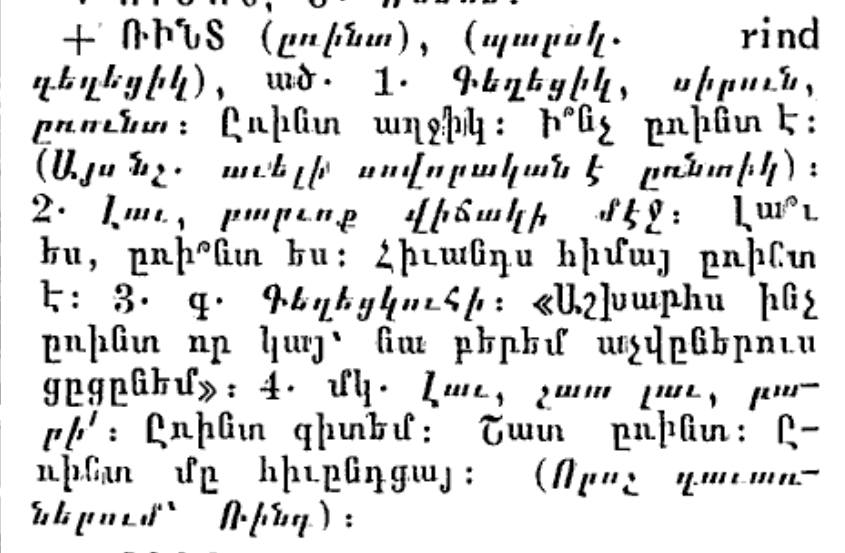
Let us begin with one of the pillars of Armenian linguistics, Academician Stepan Malkhasyants’ four-volume Armenian Explanatory Dictionary. Published in 1945 (specifically, State Publishing House of the Armenian SSR, Yerevan, page 162), this fundamental work remains an irreplaceable treasury of the Armenian language.
Malkhasyants provides explanations for the words “rind,” “rint,” and “errint,” emphasizing their meanings. He notes that these words signify “beautiful,” “handsome,” “attractive,” and “worthy of pride.” In other words, according to Malkhasyants, the name Rind was originally associated with aesthetic values and a sense of dignity.
Source 2: “Hairenik” Monthly, 1935
Parallel to Malkhasyants’ dictionary, noteworthy information is also found in the July 1935 issue of the Hairenik monthly (No. 9, page 44), published in Boston. This publication also mentions the word “rind” and provides its interpretation.
The magazine confirms Malkhasyants’ definitions, stating that the word “Rind” means “beautiful, attractive, worthy of pride.” This further reinforces the view that our village’s name embodies positive and noble qualities.
Source 3: Armenian Dictionary, 1633
n the Latin-Armenian explanatory dictionary “Dictionarium Armeno-Latinum” (Dictionary of the Armenians), published in Paris in 1633, the word “rind, erind” (ռինդ, ըռինդ) is translated using the terms formosus, elegans, venustus.
What Does This Mean for Us?
The combination of these three important sources allows us to conclude that the name of Rind village is not accidental. Since ancient times, it has symbolized beauty, charm, and that which is worthy of pride. Perhaps the village was so named because of its unparalleled natural beauty, the unique characteristics of its inhabitants, or simply the historical role it has played.
This etymology gives us yet another reason to be proud of our village, its history, and its name, which is a work of art in itself. The word “Rind” is not just a combination of sounds; it is a meaning hidden deep within the Armenian language, calling upon us to see beauty and value pride.