 13°
13°  13 կմ/ժ


Language is the collective memory of a nation, and a dialect is the deepest, most delicate, and most enduring layer of that memory. While a literary language is formed by rules and conventions, a dialect is born from the soil, the climate, labor, daily life, and historical destiny. It lives not in books, but on the lips of the people, within their everyday speech.
To many, speaking in dialect may seem like a mere local “habit” or a linguistic deviation. In reality, it is a living bridge spanning millennia, connecting us to the mindset, worldview, and linguistic taste of our ancestors. The sub-dialect of Rind village is exactly such a bridge.
How Dialects Are Formed
The formation of dialects is a natural yet complex historical process. In a mountainous country like Armenia, where canyons and mountain ranges have separated communities for centuries, the language inevitably began to “branch out.”
Geographical isolation, limited contact with neighboring settlements, the influence of foreign rule, as well as forced migrations and returns, created linguistic environments where the same Armenian language developed in different directions in different places. Consequently, every province and every village acquired its own characteristic intonation, vocabulary, and grammatical nuances.
Dialects can be considered the “storehouses” or “laboratories” of a language, where ancient forms of Armenian have been preserved—forms that have long since disappeared or changed in the literary language.
The “Ancient Armenians” and Their “Ancient Armenian”
A spontaneous yet profound conviction has long circulated in Vayots Dzor: we consider ourselves “Ancient Armenians” and our speech “Ancient Armenian.” At first glance, this might seem like folk vanity, but it is rooted in a genuine historical layer.
Scientific studies show that a portion of the population of Vayots Dzor (unlike those resettled from Khoy, Salmast, or other regions) is the descendant of the indigenous population of that region. These people managed to escape the forced deportation of 1604 by Shah Abbas or were among the first to return to their ancestral land.
This historical continuity brought with it linguistic continuity. What the people call “Ancient Armenian” is known in linguistics as the Vayots Dzor inter-dialect (or the Jahuk-Vayk inter-dialect), which belongs to the “um” branch of Eastern Armenian.
A Scientific Perspective: The Dialect Map
This Vayots Dzor inter-dialect is spoken in Rind, Aghavnadzor, Areni, Khachik, Nor Aznaberd, Gndevaz, and several neighboring villages. Notably, the great Armenian linguist Hrachya Acharyan did not classify this speech within either the Araratian or the Artsakh dialect groups, viewing it as an independent and unique unit.
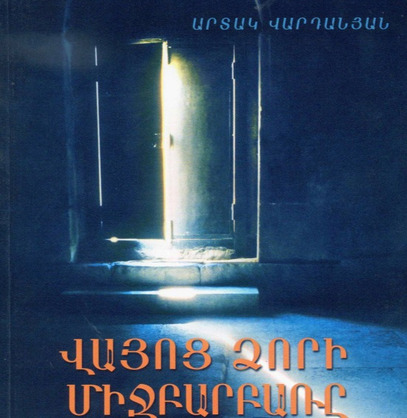
In modern dialectology, particularly in the studies of Artak Vardanyan, it is shown that the roots of this dialect reach back to the layers of Middle Armenian. This is evident not only at the phonetic level but also at the lexical and grammatical levels. Artak Vardanyan also mapped the specific characteristics of the Vayots Dzor speech by settlement, according to which the Rind sub-dialect is closest to the speech of Areni, Aznaberd, and Aghavnadzor.
The similarities between the colophons of ancient manuscripts and our daily speech are sometimes astounding:
Ancient Manuscript: Dzerrs t’ilats’aw (My hand grew weak) → Dialect: Tserrs t’ilats’av
Ancient Manuscript: Im q’irn merraw (My sister died) → Dialect: Im q’yir’s merrav
Ancient Manuscript: Min kov tui (I gave one cow) → Dialect: Min kov t’vim
These similarities are not accidental; they are different temporal layers of the same linguistic flow.
What Makes the Rind Sub-dialect Unique?
The speech of Rind and neighboring villages is distinguished by its unique “softness” and gentle sound. This softness is not random; it stems from an ancient phonetic system.
Palatal Sounds
Soft palatal sounds—gy, ky, k’y—have been preserved in our speech: kyini (wine), k’yir (sister). These have almost vanished in literary Armenian but continue to live among us.
Stress Placement
While stress in literary Armenian usually falls on the last syllable, in the Rind sub-dialect, it often falls on the penultimate (second to last) syllable: pa՛zug (beet / arm), ka՛runk (spring), a՛ngaj (ear).
The Use of “F”
In Areni, Rind, and Aghavnadzor, the “h” sound is often replaced by “f”. This is the most recognizable “calling card” of the dialect: fōgh (soil/earth), fōrt’ (calf), fōril (to bury/pit). This phenomenon is not a corruption; on the contrary, it has preserved an ancient phonetic layer.
Grammatical “Antiquities”
The Rind sub-dialect has surprisingly preserved grammatical forms from Classical Armenian (Grabar) and Middle Armenian. One of the most interesting is the formation of the plural.
In the speech of Aghavnadzor and Rind, the Classical Armenian “k’” suffix is still used: kyinik’ (wines), meghuk’ (bees).
Furthermore, our linguistic mindset “arachaizes” even modern words, subjecting them to the same ancient rules: avtok’ (cars), kyinok’ (cinemas), motok’ (motorcycles).
This shows that the dialect is not a frozen system but a living language that accepts the new through its ancient logic.
Dialect as Cultural Heritage
When we say rekha (child), angaj (ear), planiq (key), or zanqach (mother-in-law), we are not speaking “incorrectly”—we are speaking the way our grandfathers and their grandfathers spoke. These words take us back to the tonratun (bakery), the old courtyard, the vineyard—the environment where language was not “taught” but inherited.
Even the shifts in sounds—t’ōren instead of t’onir (clay oven)—have their own internal logic and historical basis. Dialect is a part of our cultural DNA.
The Vayots Dzor inter-dialect is an inseparable part of our highlands. It has been nourished by the intellectual environment of Gladzor University, the inscriptions carved onto the stones of Noravank, and the taste of our soil, water, and labor.
Today, when we hear that soft, familiar speech in Rind or Aghavnadzor, we must realize: we are not just hearing a dialect, but the living breath of a thousand-year history.
Let us preserve our dialect. Not as a museum specimen, but as living speech—because it is the very language through which our heart speaks to our land.
References: Artak V. Vardanyan, “The Inter-dialect of Vayots Dzor,” Tigran Mets Publishing, 2004