
 14°
14°  14 կմ/ժ


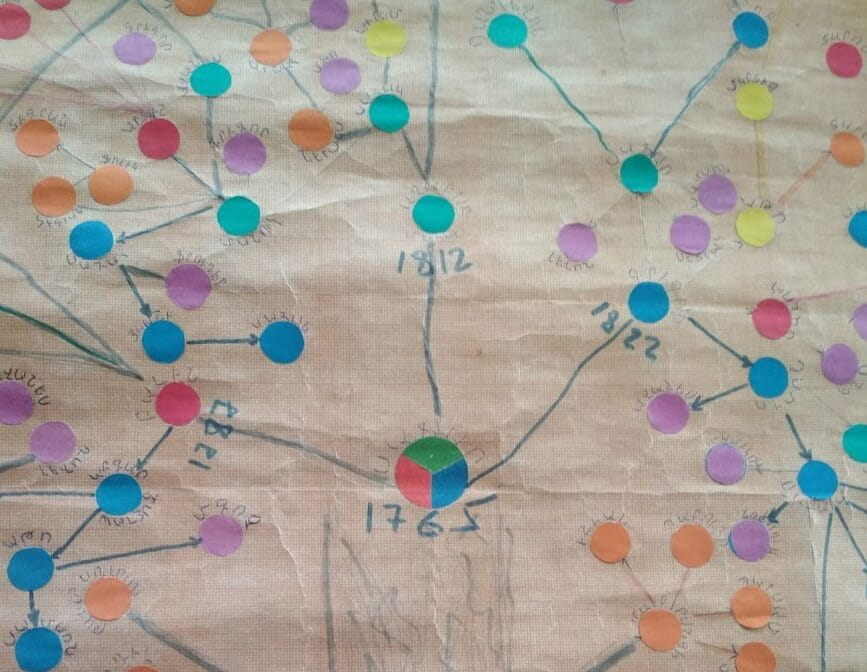
One of the largest and founding clans of Rind village is the Melik-Safar dynasty, the history of which stretches from medieval Ani to Syunik, Nakhijevan, and Vayots Dzor. Historical sources testify that in 1828, after the Treaty of Turkmenchay, when mass repatriation of Armenians to Eastern Armenia began, the village of Old Rind—abandoned for centuries—received a new breath of life. It was during this period that Melik-Safar’s three sons—Balin, Aghabab, and Grigor—settled in Old Rind, becoming the pillars of the village’s modern history.
Studies by ethnographer Yervand Lalayan reveal the clan’s noble origin. The clan’s ancestor, Stepan, lived and gained fame in the Bagratid capital of Ani, where he received the title of Melik (Sardar) and the position of military commander. After the devastating earthquake of 1319, Ani was completely abandoned, and it is assumed that the clan left the city at that time.
After leaving Ani, the clan briefly settled in the village of Shahriar in the Etchmiadzin region. Historian Henzel Arakelyan notes in his book “History of Brnakot“ (1997) that they had a conflict with the local Shahkhatunis there, which led to bloodshed and forced the clan to migrate again.
Nakhijevan (Jahuk)
From at least the second quarter of the 14th century to the beginning of the 19th century, the clan’s main shelter was the village of Jahuk in Nakhijevan. Although written sources are scarce at the moment, oral traditions testify to the clan’s role in the construction of one of Jahuk’s churches.
Leaving Nakhijevan, the clan was represented by five brothers, whose father, according to archival materials, was Great Agha Baba (Aghabab). Fate took the brothers in different directions.
Melik-Tangi I
Continuing his father’s melik title, he settled in the village of Brnakot in Syunik, laying the foundation for the famous Melik-Tangyan dynasty. The clan reached the peak of its power under Melik-Tangi II, who built the bell tower of the St. Grigor Lusavorich Church in Brnakot (where his tombstone is located) and the famous Melik-Tangi Bridge over the Vorotan River. From this branch came Archbishop Nerses Melik-Tangyan, the primate of the Armenian Diocese of Atropatene, historian, and author.
The Other Brothers
No precise information could be found about three of the brothers at this moment. Their names were Hovsep, Avtandil, and Tavat. Years ago, Kamo Safaryan, a representative of the clan, told me that it is likely one of the brothers moved to Tabriz, and another to Artsakh.
In the February-March 1956 issue of the Hayreniq magazine, recounting his and Armenia’s Minister of War Ruben Ter-Minasian’s stay at Mher Balyan’s house in December 1920, Commander (Khmbapet) Martiros of Bashgarni reveals that the grandfathers (great-grandfathers) of Mher Balyan, Nerses Melik-Tangyan, and Sergey Melik-Yolchyan were brothers.
The kinship with the Tangyans is documented, but I have not yet been able to find information regarding the connection with the Melik-Yolchyans (if you have any information, please contact me).
Melik-Safar (born 1756)
Melik-Safar was born in 1756. While moving from Nakhijevan to Vayots Dzor, the ancestors briefly stayed in the village of Arpa (Areni). It was here that the father of the clan, Safar, died. His tombstone has been preserved to this day and is located in the settlement of Old Arpa, near the St. Astvatsatsin Church, in the historical area that was once the residence of the Orbelian princely house.
Melik-Safar’s three sons—Balin, Aghabab, and Grigor—founded three large branches in Rind. Despite the branching, the representatives of the clan maintain the sense of blood ties, accepting each other as relatives—as “cousins.”
1. Balin’s Branch (Balinenq)
The eldest son, Balin, was born in 1787.
Sons: Asatur, Mkrtich, Khachatur, and Abgar (Palyoz).
Their sub-branches also created large clans (Mkrtichenq, Asoyenq, Khachoenq).
Khachatur’s sons: Karo and Smbat. The clan bears the surname Khachatryan.
Aso’s sons: Arakel, Aram, Tigran, Parsam, and Misak. The clan bears the surnames Asatryan and Aramyan.
Abgar’s sons: Ato and Saqo.
Mkrtich’s sons: Nikolay-Mher, Yenoq, Yegho, Margar, Zaqara, and Hayrapet (Habo). In Rind, representatives of this branch now bear the surname Mkrtchyan. There are descendants of Yenoq in Areni.
Notable Figure: Nikolay-Mher Balyan (son of Mkrtich), a devotee of the national liberation struggle of the early 20th century. He was christened with the name “Mher” by General Andranik. He was part of the Vayots Dzor command staff and, together with Yapon (Hovhannes Paronyan), organized the defense of the province against Tatar gangs.
2. Aghabab-Mukhsi’s Branch (Mkhsonq)
The middle son, Aghabab, was born in 1812. Aghabab was also known as “Mukhsi”. The term (Mahtesi) is defined as a faithful person who has gone on a pilgrimage to Jerusalem (Eduard Aghayan, “Explanatory Dictionary of Modern Armenian”, 1976, p. 959).
Mukhsi Aghabab was the blacksmith of Rind and played an invaluable role in the establishment of the village, particularly in the construction of its water line. In the 1830s, when the seven founding households of Rind set out to bring water from Ulgyur, they had to dig a canal through about two kilometers of desolate, rocky terrain in the Aghavnadzor field. While one man from each of the other six families was cutting through the bedrock, Mukhsi Aghabab worked day and night in his forge, hammering and sharpening their tools—shovels, spades, crowbars, and pickaxes. This arduous, titanic labor, which lasted for more than a year, was crowned with success, and life-giving water finally reached Rind.
His sons were Avetis (b. 1846) and Sahak (b. 1844).
Sons: Avetis (born 1846) and Sahak (born 1844).
Sahak’s sons: Nerses, Manuk, and Yeprem. In Rind, the clan surnames are Sahakyan and Nersisyan.
Avetis’s sons: Karapet, Aghabek, and Hazarberk. In the village, the branch surnames are Avetisyan, Karapetyan, and Aghababyan.
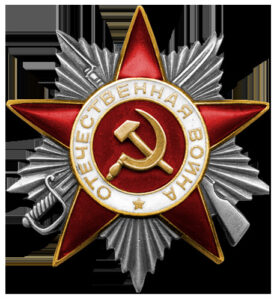
Notable Figure: Aristakes Avetisyan (son of Karapet, born 1910) participated in the Great Patriotic War (WWII) and was awarded the “Order of the Patriotic War 2nd Class”.
3. Grigor’s Branch (Grigorenq)
The youngest son, Grigor, was born in 1822. Sons: Simon, Safar, Manuk, and Harutyun.
Simon’s sons: Avanes, Zaqara, and Misak. Zhorzhik Grigoryan (son of Zaqara) was a physics teacher at Rind Secondary School for many years and served as principal for a period.
Notable Figure: Yenok Safaryan, (son of Safar). During the most difficult and fateful moments of the early 20th century, he assumed the responsibility of a leader, becoming one of the key commanders of the Vayots Dzor self-defense forces.
The main surnames of this branch are Grigoryan, Safaryan, Manukyan, Simonyan, and Harutyunyan.
All three clans originating from the great Melik-Safar are now present in Rind village.
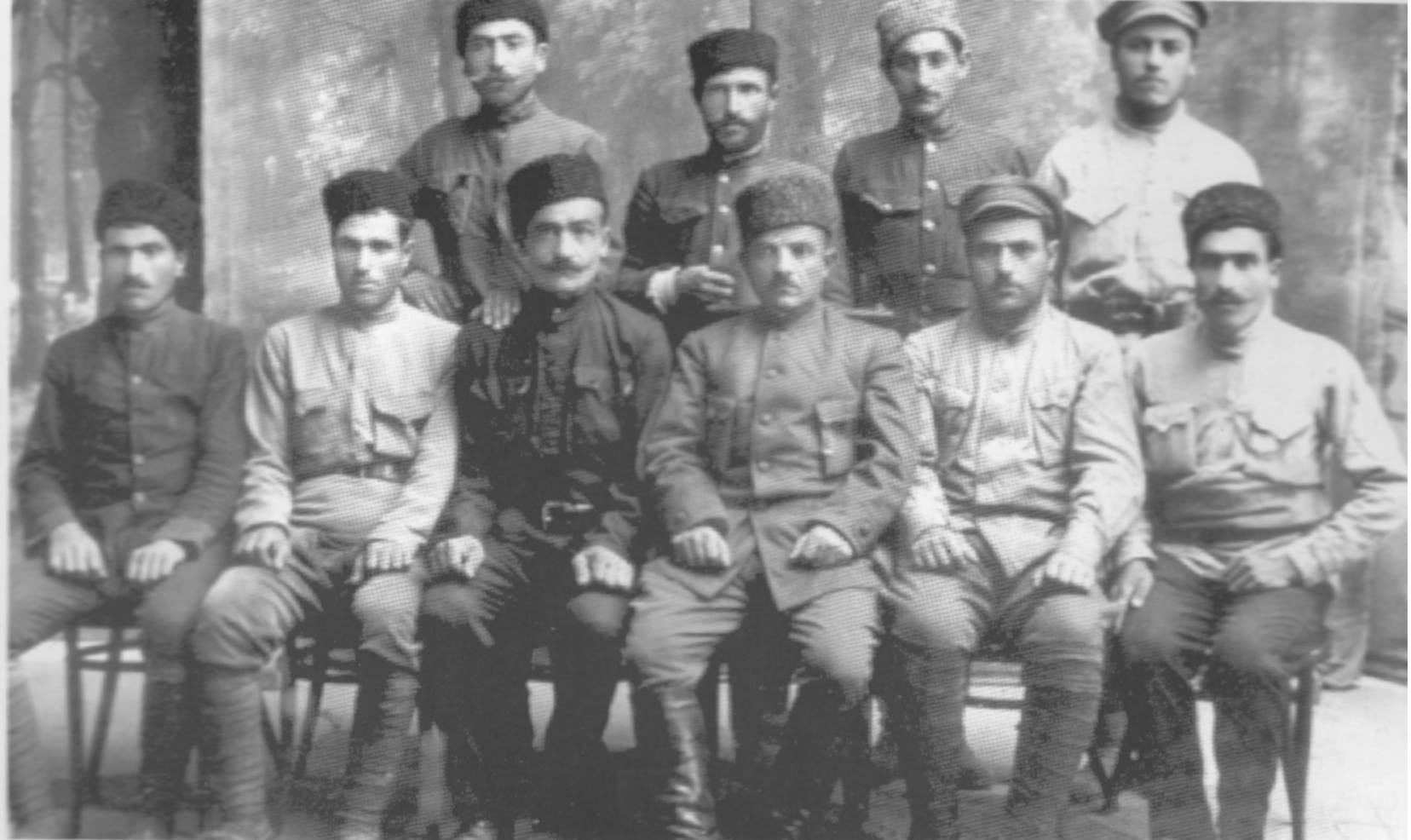
The photo shows Mher Balyan (Balin’s grandson) and Yenoq Safaryan-Grigoryan (Grigor’s grandson) from Rind, with the Vayots Dzor command staff, early 20th century. Yapon is in the center.
From the Author: I myself am from this clan, from the branch of Melik-Safar’s son Aghabab > Avetis > Karapet > Kristapor > Hrant > Ashot > Narek.
I have compiled and posted the entire interactive family tree of the clan—with more than 610 male members—on the website, which is in the stage of replenishment and verification. In case of suggestions, opinions, or noticing inaccuracies, please contact me.
Please contact via the website in case of any inaccuracies, additions, or suggestions.