
 13°
13°  12 կմ/ժ


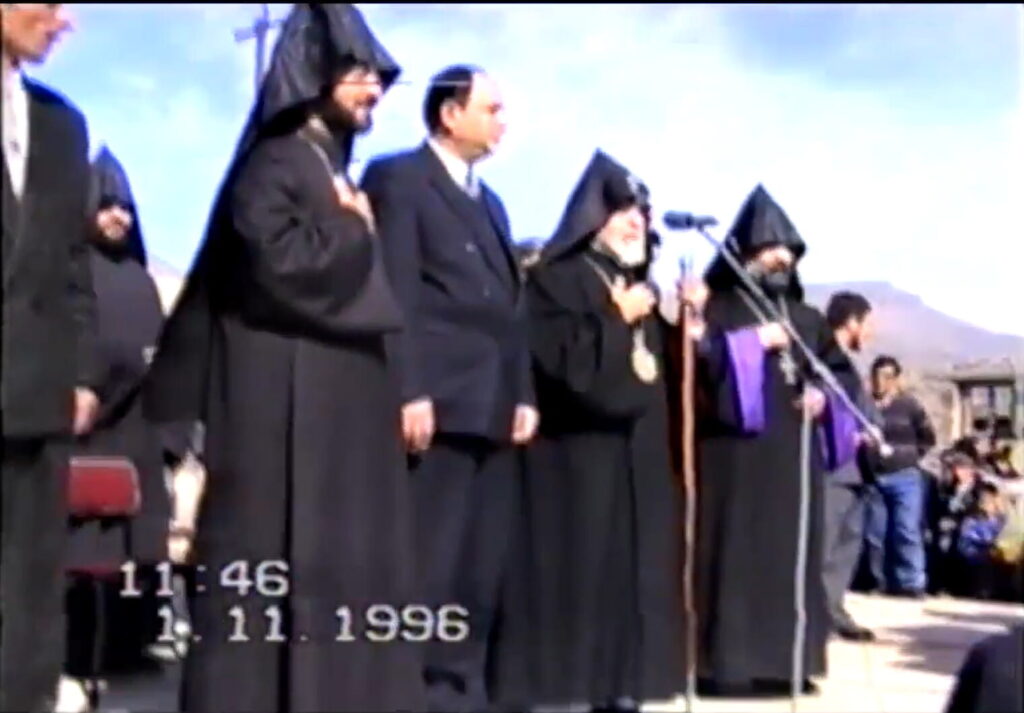
In the modern history of Rind, there are events that divide time into “before” and “after.” November 1, 1996, was exactly such a day—a day when a seemingly impossible dream became reality, and life-giving water finally entered the village.
After relocating from the old settlement to the current site in 1966, Rind faced a severe crisis: the lack of irrigation water. For a community with rich agricultural traditions, this was an existential issue. Small-scale local solutions were insufficient even for household needs, leaving the land parched. Years prior, a project by Aghasi Khanjyan had been developed to bring water via pipelines from the Yeghegis River, but the program was plagued by delays and growing complications. A new, bold solution was needed.
That solution was found, and it was as daring as it initially seemed unfeasible. The author of the project was Archbishop Abraham Mkrtchyan, Primate of the Diocese of Syunik and a native of Rind.
The concept was to draw water from the Gnishik River (a left tributary of the Arpa) near the historic Chapel of Saint Phocas in the Noravank canyon and bring it to the northern section of Rind via a gravity-fed pipeline through rugged terrain. At the end of the 20th century, this vision took shape. Through the joint efforts of the Diocese of Syunik and the Eastern Diocese of the Armenian Church of America (represented by the Fund for Armenian Relief – FAR), the 24-kilometer “Noravank-Rind” pipeline was constructed.
November 1, 1996
By the autumn of 1996, construction was complete. November 1 became a day of national celebration in Rind. Villagers of all ages, along with guests from neighboring communities, gathered to witness the arrival of the water.
The importance of the event was underscored by the distinguished guests in attendance. To participate in the opening ceremony, His Holiness Karekin I (Sarkissian), Catholicos of All Armenians, arrived in Rind. His presence brought a blessing not only to the water but to the entire community.
Among the guests of honor were:
- Archbishop Abraham Mkrtchyan, Primate of the Diocese of Syunik
- Ashot Voskanyan, RA Minister of Agriculture and Food
- Pandukht Manukyan, Governor of Vayots Dzor
- Bishop Nathan Hovhannisyan, Primate of the Armenian Diocese of Ukraine
- Reverend Artak Tigranyan and Archbishop Bagrat Galstyan
- Yeznik Palyan, Director of the FAR Armenia Office
The atmosphere was filled with jubilation and gratitude. Special thanks were offered to all supporters of the project, particularly Archbishop Khajag Barsamian, Primate of the Eastern Diocese of the USA, and the entire staff of FAR, through whose direct efforts lands resembling a desert were transformed into blooming orchards.
The climax of the day was the patriarchal blessing and message of Catholicos Karekin I. In his speech, the Pontiff described water not merely as a material good but as a symbol of spiritual rebirth, calling on the people of Rind to cling firmly to their ancestral land and make it prosper.
The opening of the Noravank-Rind pipeline became a turning point for the village’s economic development, laying the foundation for the viticultural and agricultural success that Rind takes pride in today.
The Speech of His Holiness Karekin I, Catholicos of All Armenians
Rind Village, November 1, 1996
“Dear spiritual brothers, honorable representatives of our state authority—in the person of Minister of Agriculture Mr. Manukyan—and very dear, precious children of Rind and the surrounding villages:
This day is a bright day in the history of this region, and with my first words, I want to tell you all that November 1 shall be recorded in the history of our Church, in the history of the Catholicosate of All Armenians in Holy Etchmiadzin, in one of the brightest pages of our history books, as The Day of Rind. Naturally, I feel it, and you feel it too: it is no ordinary event for a Catholicos of All Armenians to be present in every village. I could have sent a bishop or a representative today to represent our Holy of Holies, the Mother See of Holy Etchmiadzin. But I must say, I must confess, that I desired with a great desire to come in person.
I came, first of all, led by an inner impulse, because I was born in a village, I grew up in the soil, I watered the earth, and I mixed my life with the land and the various expressions of peasant life until I was fourteen years old. For thirteen years of my life, I never saw such a thing as electricity. I studied and learned by the light of a candle; I sometimes walked through orchards at night by the light of a torch (makhri).
The village lives in me just as blood lives in my body. Village life is, for me, that wonderful way of existence where the nature created by God and the man created by God blend together to bring life out of the earth. Cities, naturally, have an important role in the development of human society. I have lived in big cities, very large cities, but the spirit of the village has never died, never faded in my soul, and today, from within your village, I greet all our rural regions throughout the land of Armenia.
Today, under this bright and blue sky, amidst these snow-capped mountain peaks and this mountainous embrace, I ask: How does God look upon us from heaven? I feel that God is smiling from heaven seeing you, seeing this faithful attachment of yours to our soil, to the Fatherland, to the State, and to the Church. And he who brings a smile to God is a worthy child of God, for we received life from Him. He gave us the land—we did not create the land with our own hands—and hands were given to us to bring life out of that land.
You surely know one of those first words of the Bible which says: ‘It is man who works the earth,’ and that by the sweat of your brow you shall earn your life. That is the commandment given by God. Our hands were meant to draw life from this soil. A moment ago, when you were applauding your Holy Father, after the words of our state representatives, a thought crossed my mind. These hands were not meant only for applause; these hands were not meant only for eating, drinking, and smoking. The more we decrease the use of our hands for smoke, the more we decrease the use of our hands for drink, and the more we strengthen the use of our hands for the pen—you, school children, children of my honorable people—the more you strengthen the touch of your hands upon the soil, the more goodness you will reap, and the happier you will be.
Beloved ones, I, who have lived in foreign lands, feel and have seen in others the pride they have for their state. And first, he who does not respect himself should not expect respect from others. It is we who must respect ourselves; it is we who must strengthen our state. And today, in the person of the Minister of Agriculture, I welcome our state’s care for its people. And as Catholicos, Father of all, I say today: Dear state representatives, if until now you have done one part, from now on you must do two and three, so that you may be worthy of the love and respect of this people. And so, with this idea, I greet you and our dear Governor, Mr. Manukyan, and all those responsible for these villages, so that they may bring their participation to you widely, with the open-hearted and ready participation of all.
I still have more to say. I am sure you are all waiting, because what I am about to say I pluck from the hearts of every single one of you and, like a bouquet of flowers, I direct this word of appreciation to the spiritual leader and our spiritual son, Father Abraham, to commend his devotion—a devotion of an exceptional kind. I have one thing to say to him from now on: you may become a bishop, you may become a catholicos, but never cease being a vardapet (teacher/preacher).
I direct my words of appreciation to the Primate of the Eastern Diocese of the Armenian Apostolic Holy Church of America, Archbishop Khajag Barsamian, to the Diocesan Council, and also to the Fund for Armenian Relief and its leaders, headed by Mr. Yeznik Palyan. I know them all very well; I have been there in America, I have seen them. And I perceive their care as a living, tangible, and profound expression of their love—toward the Mother See of Holy Etchmiadzin, toward the children of our Armenian Apostolic Holy Church living in Armenia, and toward you, the residents of this region’s villages.
Beloved ones, think for a moment. People sitting thousands of miles away in New York City or spread across America, Armenians who have not seen Armenia, but whose hearts and souls recognize no geography—they love it. Love has no borders. They work, but they set aside a portion of their labor for their Fatherland, for the children of their Church. We need to understand our life as a service to God; and service rendered to God, the Fatherland, the Church, culture, school, books, and literature is what will make us happy. Therefore, I want to express my highest degree of appreciation to them as well, and to all those individuals who, personally or as an organization—American or Armenian—brought their share to the success of this magnificent, vital work.
Finally, ‘water’ is one of the most frequently used words in the Gospel. Water is as vital as bread and light. Without water, without bread, and without light, life cannot be imagined. Jesus Himself said: ‘I am the living water.’ Water is material. Water is necessary for our physical existence. But there is another water, a spiritual fountain, the water of the soul; that water which, when a person drinks it—that consciousness, that idea, that faith, that love, that sacrifice—one feels that it brings a person to life, that it is living water.
Are we only flesh and bone? Are we only a physical existence? Do we only have a course of life for eating, drinking, pleasuring ourselves, and dying? No, brothers and sisters. Life is also the enjoyment of spiritual and intellectual experiences. And for that reason, I was so filled with joy today when, walking up the slope of this village, I saw these children. You, dear school children, have made me so happy. I want there to be a smile on your faces always—always, even in pain. A smile is the presence of God within us. We must meet life with optimism.
We have finally reached a consciousness where we are both the servant and the master of this land. We cannot be the master of this land without being the servant of this soil. I cannot be the head of the Church without being the servant of the servants of this Church. I have not become Catholicos for the sake of the Throne or the office. I want to be a Catholicos for the people, among the people, and with the people. This is the Christian understanding of our Church, and today I have come to dedicate this day to you as God’s translation in your life. And let this water be not only material water to irrigate your lands, but let this water also be a spiritual, moral, national, and cultural renewal for these children and for the generations to come.”