 13°
13°  4 կմ/ժ



When speaking about the fertility of Rind’s land and the unbreakable diligence of its people, we often rely on legends and memories. However, historical documents and official statistics come to prove that our village was an undisputed agricultural leader of Vayots Dzor (the former Yeghegnadzor region) for decades.
An analytical article published in the March 3, 1960 issue of the “Leninyan ughiov” (Along Lenin’s Path) magazine of the Central Committee of the Communist Party of Armenia provides exceptional data on the unprecedented successes recorded by the Rind collective farm (kolkhoz) in both viticulture and tobacco farming.
Unsurpassed Viticulture Indicators
In the late 1950s, grape yields in the region began to grow, but Rind’s figures were simply astounding, doubling the overall average.
The magazine states:
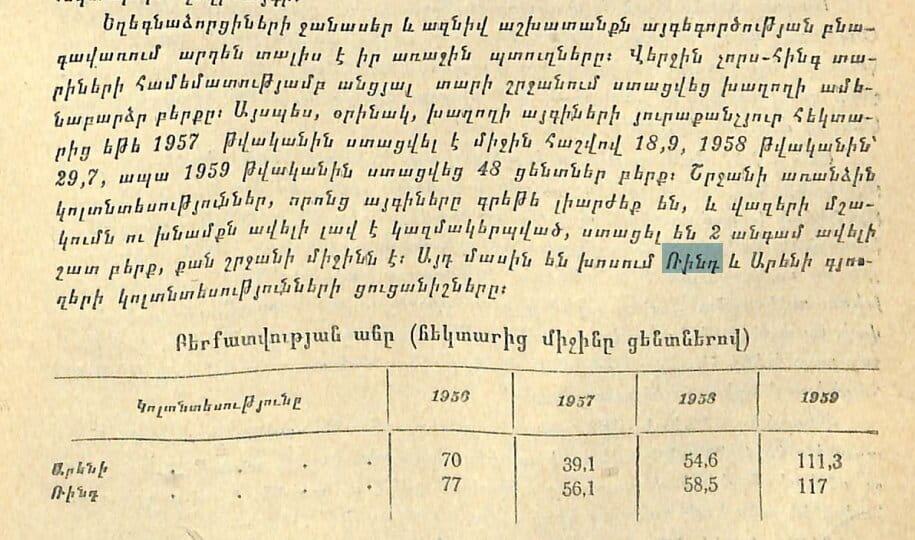
“…if in 1957 the average yield per hectare of vineyards was 18.9 centners, and 29.7 in 1958, then in 1959 it reached 48 centners. Certain collective farms in the region… received twice as much harvest as the regional average. The indicators of the Rind and Areni collective farms speak to this.”
The preserved archival table shows a fantastic growth in yield: if in 1956 Rind’s vineyards yielded 77 centners of grapes per hectare, by 1959 this figure reached a record 117 centners, surpassing even neighboring Areni (111.3 centners). The author emphasizes that the soil and climatic conditions in the region were almost identical, and Rind’s secret was the proper care of the land and the competent, dedicated work of the villagers.
Absolute Leader in Tobacco Farming
Another crucial branch was tobacco farming, where Rind again occupied the first honorable place in the entire region. Thanks to well-organized plantations and plant nutrition, the following indicators were achieved in 1959 (per hectare):
- Rind: 31 centners
- Malishka: 27 centners
- Getap: 25 centners
- Areni: 22 centners
- Yeghegis: 21 centners
A Strong Economy
This relentless work immediately reflected on the village’s economic power. According to 1960 data, the Rind collective farm generated an income of about 700,000 rubles, which was a colossal sum for those years, allowing for the development of the village infrastructure and the improvement of the residents’ living standards.
These archival data prove once again that the land of Rind is gold, but it only creates when mixed with the honest and diligent sweat of its people. Even today, looking at the records set by our grandfathers, we have a great obligation to be proud and to continue their work with the same spirit.