
 6°
6°  7 կմ/ժ


Armenian museum collections are rich with exceptional artifacts that are often not fully known to the public. The findings discovered in the territory of Rind village constitute one such fascinating layer. Today, around 28 specimens are preserved in Armenia’s three largest museums—the History Museum of Armenia, the State Museum of Nature, and the Geological Museum of Yeghegnadzor. These items tell the story of Rind, spanning from prehistoric times millions of years ago to the lifestyle and culture of the 19th century.
When speaking of Rind, one must first mention the exhibits kept at the State Museum of Nature. This collection of 19 specimens takes us back to the Paleogene and Eocene epochs. The discovered fossils—Terebellum sopitum, Cepatia cepacea, Velates schmidelianus, and various species of sea urchins and shells—are undeniable evidence that millions of years ago, this area was covered by warm oceanic waters.
These findings are not merely petrified remains; they are vital scientific sources that allow us to reconstruct the geological history of the region. For instance, the presence of the large and well-preserved Polyplacidia sea urchin or the Miltha gigantea shell speaks to the rich aquatic biodiversity and favorable climatic conditions of that era. These specimens mostly reached the museum in the 1950s-70s, thanks to research conducted by the YSU Faculty of Geology and the Academy of Sciences.
Traveling through millennia, we arrive in 19th-century Rind, whose history is vividly represented in the Geological Museum of Yeghegnadzor. The artifacts kept here mainly relate to applied arts and daily life. Notable are the bronze and silver decorative buttons—belt ornaments featuring almond-shaped and floral patterns. They symbolize the rebirth of life and the human connection with nature.
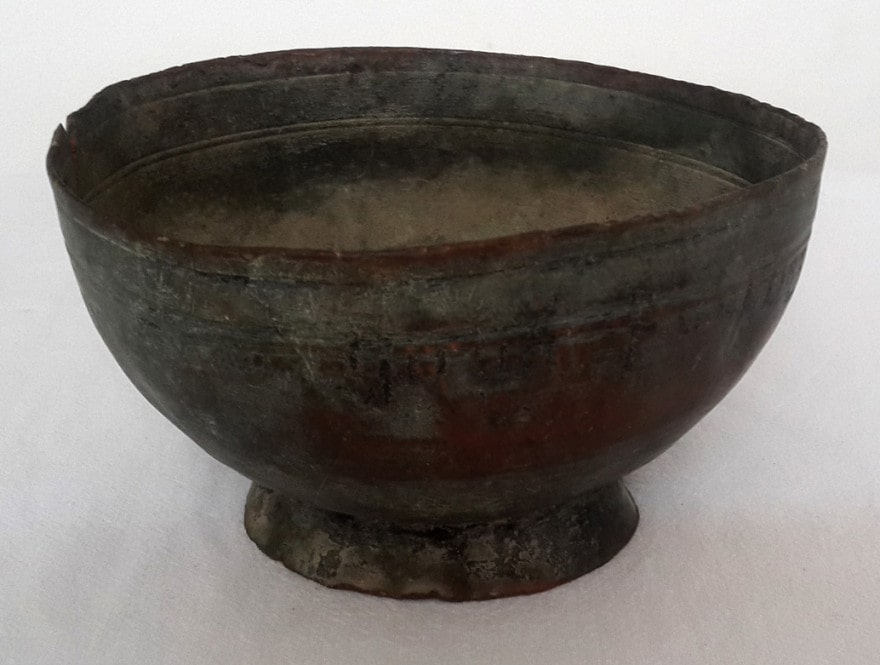
The copper bowl made in 1856 deserves special attention, as it bears the name of the master, Aleksan Batalov. This proves that metallurgy was well-developed in Rind and neighboring settlements, and the locals highly valued the individual work of craftsmen. An ornamental tray and other household items kept in the same museum attest to the refined aesthetic taste and domestic craftsmanship skills of the people of Rind.
Another important layer of Rind’s history is preserved in the History Museum of Armenia in the form of photographic negatives. Captured in 1934 by photographer Anushavan Shiroyan, these frames convey images of the village’s spiritual monuments, which look different today.
The photographs depict cross-sculptures (khachkandaks) embedded in the walls of the village’s old school and a khachkar (cross-stone) inside a half-ruined chapel. These findings testify to the rich medieval Christian culture and spiritual life of Rind. The inscriptions on the khachkars, visible on the negatives, are valuable historical documents that help reconstruct the chronology of the village’s historical events.
Scattered across different museums, these 28 specimens actually form a single portrait of Rind. They prove that the ancient power of nature and human creative thought are intertwined here. From fossilized shells to silver buttons and medieval khachkars, all of these are living witnesses to Rind’s past, awaiting new researchers and visitors.
The complete list of specimens is available at this link.