
 5°
5°  8 կմ/ժ


The Vishapakars (Dragon Stones) of Rind: From Ancient Worship to Medieval Khachkars
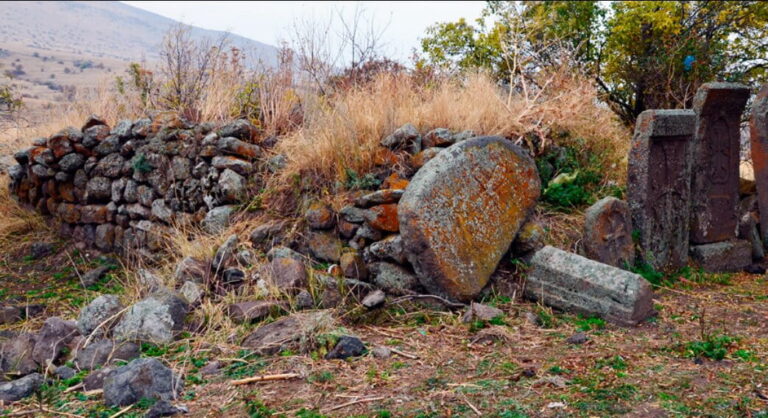
One of the most exceptional and mysterious monuments of the Armenian Highlands are the Vishap stone monuments (Vishapakars). These primeval steles, found only in our highlands, have stood in high-altitude zones for millennia, silently witnessing ancient cults, thunderstorm myths, and water worship.
Vayots Dzor and, in particular, the vicinity of Rind village, are rich in these unique historical monuments, some of which have a highly remarkable and complex fate.
Vishapakars in Vayots Dzor and the Rind Area
According to archaeological studies, a total of six Vishapakars have been discovered in Vayk, distributed in the area of Ulgyur monastery, Selim pass, as well as the vicinities of Taratumb, Yeghegis, and Rind villages.
The Vishapakars of Rind and Ulgyur are located at an altitude of about 1800-2000 meters above sea level, in the Vayots Dzor-Syunik high-altitude zone. Historically, the famous Dvin-Partav trade route passed through this area, which could have contributed to the accessibility and subsequent relocation of these monuments. Scientists do not rule out that the Rind steles once formed a common cultic group with the nearby famous Selim Vishapakars.
Christianized Monuments: Rind 1 and Rind 2
Two Vishapakars, known in scientific literature as Rind 1 and Rind 2, have been preserved in the administrative territory of Rind, in the 10th-14th century cemetery of the Verin Ulgyur settlement.
The most striking feature of these steles is that they underwent a transformation in the Middle Ages—they were “Christianized.” The front parts of these ancient pagan monuments were flattened to be used as khachkars (cross-stones) or tombstones.
Below are the main scientific characteristics of the Rind Vishapakars:
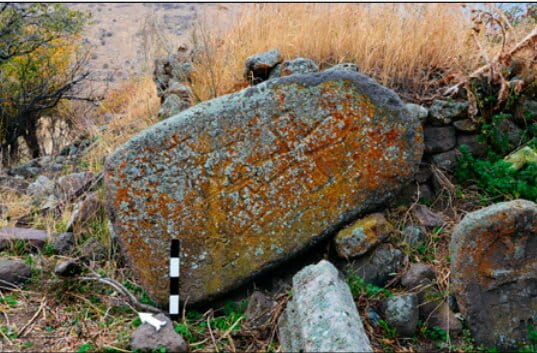
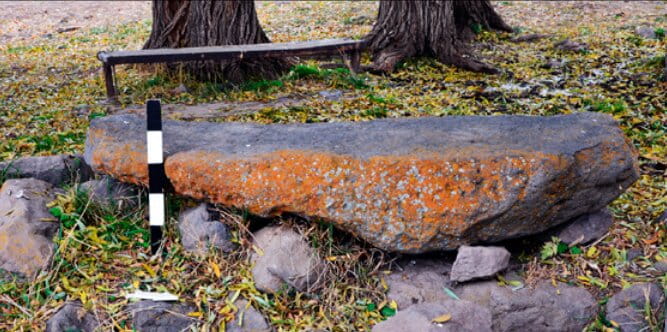
| Characteristics | Rind 1 | Rind 2 |
| Type | Bull-shaped (curving shape and crest on the head are preserved) | Bull-shaped (narrowing shape and crest on the head are preserved) |
| Material | Dark grey basalt | Light grey basalt |
| Dimensions | 187 × 101 × 39 cm | 198 × 70 × 29 cm |
| Altitude | 1941 m | 1941 m (located 10 m south of Rind 1) |
| Current state | Only half is preserved. The front part is flattened, with large and small crosses carved on it (turned into a khachkar). | The front part is flattened (old images have disappeared). There is a hole in the head part for dragging. |
| Current use | Khachkar | Intended as raw material for a khachkar, currently serves as a table. |
Summary
The Vishapakars of Rind are not only unique specimens of ancient sculpture and mythological perceptions but also demonstrate the clash and intertwining of cultures. Originally part of a pagan cult (often associated with the mythical bull and thunderstorm deities), centuries later they were adapted to a Christian environment, continuing their existence as an inseparable part of sanctuaries.
Source: The article was compiled based on data from the academic publication “Vishap stone monuments” (Yerevan, 2015) by the Institute of Archaeology and Ethnography of the NAS RA.