
 16°
16°  13 կմ/ժ


Khachkar Dedicated to the Memory of the Armenian Genocide Victims
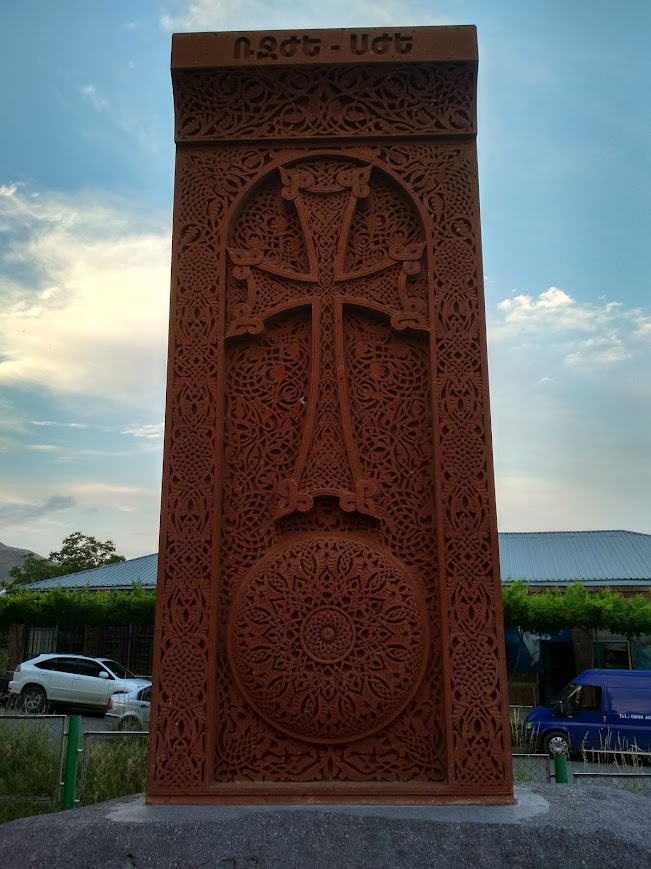
In the central park of Rind village—the Park of Glory—stands a delicate and majestic khachkar (cross-stone) dedicated to the memory of the victims of the Armenian Genocide. It was erected in 2015 to mark the 100th anniversary of the Great Metsern and has since become a focal point of the community’s spiritual life.
Creation and Authorship
The khachkar is a unique gift to the Rind community, authored and crafted by the talented sculptors Tigran Asatryan, Varazdat Asatryan, and Artur Antonyan. Through their mastery, red tuff was transformed into “stone lace,” embodying the enduring strength of the Armenian people.
Artistic and Symbolic Analysis
This khachkar is a brilliant specimen of modern Armenian stonemasonry, belonging to the classic “Amenaprkich” (All-Savior) type. It features a distinct vertical tripartite structure representing a model of the universe:
The Base (Earthly/Material): The large rosette at the bottom serves as the “Golgotha” or the “Embryo of the Universe.” Its pronounced convex shape is characteristic of the 15th–17th century and modern styles. It symbolizes the “spiritual seed” from which the Armenian nation was reborn 100 years later.
The Middle (Intercession): The central cross is “blooming” or “sprouting.” The tripartite buds at the tips of the cross wings symbolize the growth of a living tree. The palmette ornaments originating from the base of the cross create the composition of the Tree of Life, contrasting death with Resurrection and Life.
The Top (Heavenly Sphere): The cornice (top crown) houses the dates and eternity signs.
Chronology and Temporal Motion
Two significant dates are engraved in Armenian letters on the central part of the cornice:
- ՌՋԺԵ (1915): The past—a tragic occasion and the year of martyrdom.
- ՍԺԵ (2015): The present—validation of the monument’s erection and proof of Armenian survival.
The combination of these dates gives the khachkar a “temporal motion” directed toward the future, serving as an intercession for the salvation of souls.
Technical Execution
The monument carries the elegance of the Vayots Dzor school of sculpture (reminiscent of Master Momik’s style). The “double-sided cutting” technique was applied, creating deep carvings that allow for a rich play of light and shadow, making the stone appear “breathing.” Ornamental elements of pomegranate and grapes symbolize the Diaspora and spiritual rebirth.
This khachkar in Rind is not only a commemorative monument but also a ritual mediator that entrusts the souls of the 1915 martyrs to God’s care through the power of the Cross. It proves that a century later, Armenians continue to create on their ancestral land, turning stone into prayer and a testament to immortality.