
 6°
6°  6 կմ/ժ


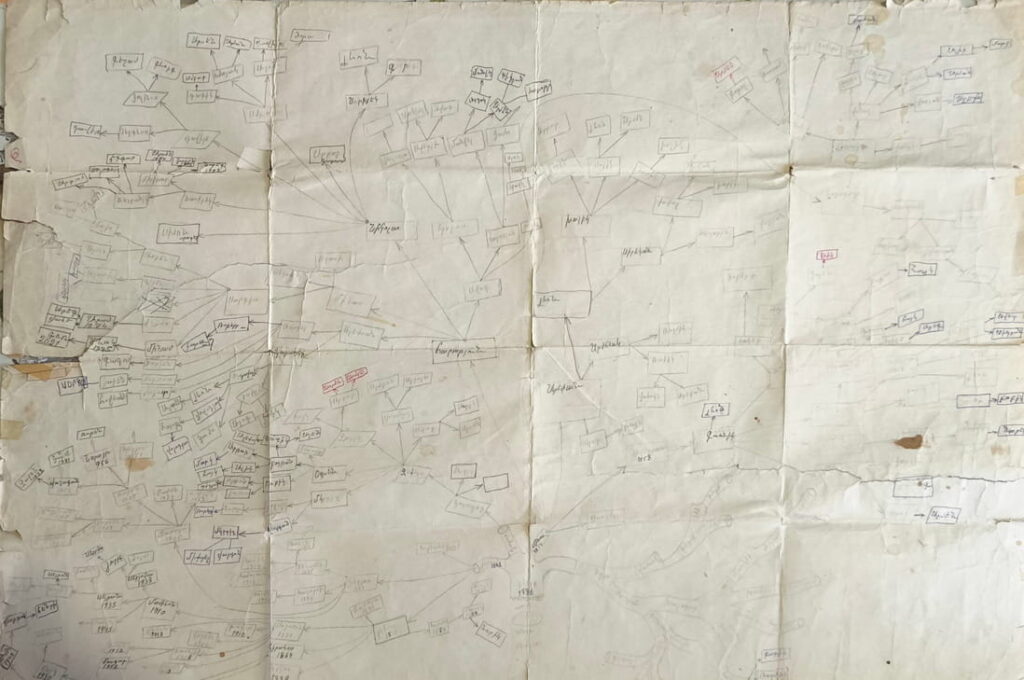
The Minasents clan holds a pivotal place in the historical annals of Rind. As one of the village’s largest families, their ancestors settled in Rind during the early stages of the settlement’s foundation, becoming among the first inhabitants to stand at the very roots of the community’s formation.
Origins and the Path of Migration
The genealogy of the clan leads us to the Ayrarat province of Greater Armenia. According to oral traditions and the memories of clan representatives, the ancestors migrated from the city of Tsolakert (present-day Igdir) or neighboring villages. Geographically, this corresponds to the historical cantons of Chakatk and Masyatsotn. Although a hypothesis about migration from the Salmast district of Parskahayq (Persian Armenia) sometimes circulates, historical and ethnographic data are more inclined to confirm the Tsolakert version.
The migration to Eastern Armenia most likely took place in the first quarter of the 19th century, connected with the Treaty of Turkmenchay of 1828 and the subsequent large repatriation of Armenians.
Before reaching Rind, the ancestors of the Minasents clan passed through a historical path of searching:
Horbategh: Initially, they settled in the village of Horbategh in Vayots Dzor. A clear proof of this is that to this day, geographical place names and land plots have been preserved in Horbategh, which the locals call by the “Minasents” name.
Aghavnadzor: Later, the clan’s patriarchs moved to Aghavnadzor. This episode is mentioned in Frunze Yesayan’s book “History of Aghavnadzor”. According to preserved information, Minas had a conflict on domestic grounds with a local named Khoytsi Harut, which became the reason for him to leave Aghavnadzor and finally settle in Rind.
The Branches of the Clan
The establishment of the Minasents clan in Rind took place before 1850, as the name of Minas, son of Gevorg, is already found in the Rind parish census documents of that year.
The founding patriarch of the clan in Vayots Dzor was Gevorg (born 1786), whose father was Ter Hovhannes. Gevorg had four sons, each of whom started a large branch. Although Minas was only one of the brothers (the eldest), when speaking about them or referring to them, they have traditionally been remembered by Minas’s name—Minasents.
Minas (born 1814): Had 5 sons: Avetis (1858), Stepan, Harutyun, Karapet, and Arakel (the latter had no heirs).
Surnames: Minasyan, Avetisyan, Stepanyan, Karapetyan.
Vardan (born 1821): The branch originating from him is known in the village as Vardanents.
Surname: Vardanyan.
Yegho: Had 2 sons: Vahan and Stepan.
Surname: Yeghyan.
Ghazar: Had one son: Karapet. From Karapet’s sons, the large branch of Zaqara stands out.
Surnames: Karapetyan, Ghazaryan.
Although these four branches were formed back in the 19th century, the representatives of the clan maintain strong blood ties, realizing their common origin and history.
Notable Figures
Living in Rind for about two centuries, the Minasents clan members were not only skilled farmers and builders but also played an active role in the educational and social life of the community. The clan has produced many worthy children:
- Henrik Vardanyan: One of the scions of Vardan’s branch. He became one of the first martyrs of the Artsakh movement, dying in June 1988 during the testing of a homemade weapon when the war was just knocking at the door. (Read more about his feat in the corresponding section of the website).
- Manvel Harutyunyan: Scientist, PhD in Philosophical Sciences. From 1977 to 2016, he carried out scientific and pedagogical activities at the Armenian State Pedagogical University as an Associate Professor of the Chair of Philosophy.
- Razmik Minasyan: A merited pedagogue who led the Rind Secondary School from 1964 to 1980, making a great contribution to the education of generations.
- Khachik Stepanyan: During the Soviet years, he was the chairman of the Rind collective farm (kolkhoz), managing the economic development of the village.
- Papaz Stepanyan: A long-time mathematics teacher who assumed the position of school principal from 1996 to 1999.
- Skryabin Stepanyan was also one of the renowned and highly respected representatives of the clan. As a distinguished mathematician, he held the responsible position of Head of the Chair of Mathematics at the Armenian State Pedagogical University (ASPU), enjoying great authority in scientific circles.
- Garnik Torosyan: The village’s chief agronomist during the Soviet era, a respected and prominent figure.
- In the complex times of the early 20th century, Karapet and Arakel Harutyunyan are also mentioned for their activities.
Passing through the difficult path of migration and resettlement, the Minasents clan dropped anchor in the soil of Rind, becoming the memory of its past and one of the creators of its future.
If you notice any omission or inaccuracy in the article, please contact us via the contact means listed on the website.