
 5°
5°  7 կմ/ժ


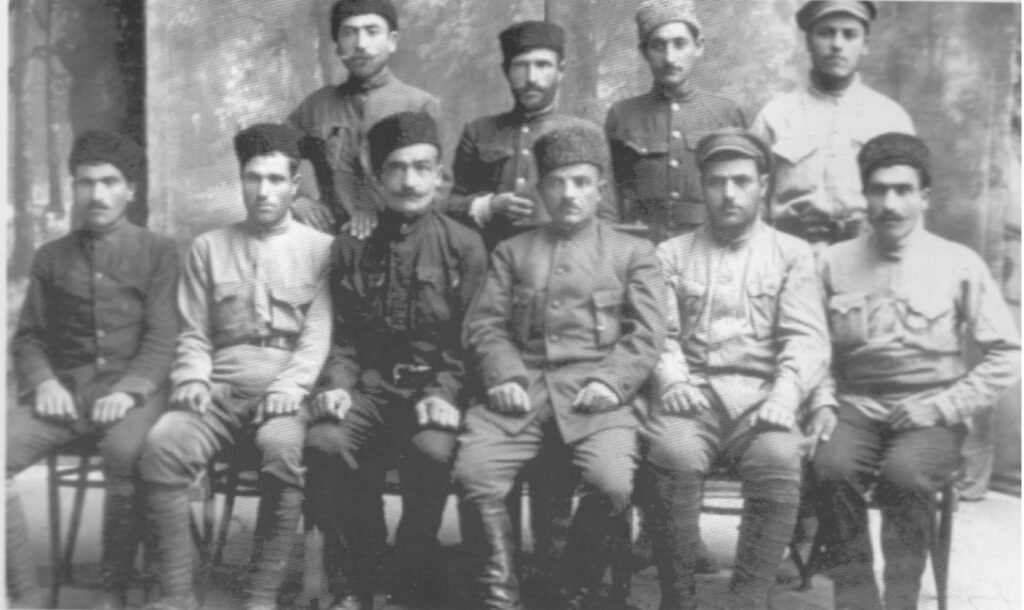
The history of Rind is rich in heroic episodes, but among them, one figure stands out, whose name has become synonymous with incredible physical strength, innate military talent, and unreserved devotion to the homeland. We are talking about the legendary fedayi Mher—Nikola Balyan.
He was born on January 4, 1878. He was a true nobleman in blood and spirit, whose roots came from an illustrious historical lineage: he was the great-grandson of Melik-Safar, the grandson of Bali, and the son of Mkrtich. He wrote the history of his homeland not with a pen, but with a sword and unparalleled self-sacrifice.
Mher’s military path began back during the Armenian-Tatar clashes of 1905-1906, when he enlisted under Aryuts Avag (Lion Avag), the commander of the Vayots Dzor combat forces, and then collaborated with the famous fedayis Kotoyi Hachu, Tsolak Aram, and Yapon (Hovhannes Paronyan).
However, one of the most pivotal episodes of his life occurred during the 1913-1915 period, at the Battle of Dilman. Nikola, along with his fellow villagers Levon Minasyan, Lyudvik Baghdasaryan, Avag Minasyan, and Patvakan Ohanyan, was serving in the Russian army, in the military unit of Major General Andranik Ozanian.
During the battles, the Turks were constantly inflicting heavy casualties on the Armenian forces from a nearby height. General Andranik lined up the soldiers and asked who could capture that deadly height with the help of 100 soldiers. After the question was repeated a second time, Nikola from Rind stepped out of the line and confidently said, “I will capture it with 4 soldiers.”
The General initially objected, but seeing the soldier’s determination, agreed to his tactic. According to Nikola’s plan, his 4 comrades were dressed in the uniforms of a Turkish centurion (yuzbashi), while he wore the uniform of a Turkish commander of a thousand (minbashi). He ordered the men simply to cover his back and moved forward. Before the enemy could realize that the approaching men were not their commanders, Nikola struck down 15-20 Turkish soldiers with his sword with lightning speed. Taking advantage of the chaos, Andranik’s unit surrounded the height and destroyed the enemy.
After capturing the height, Andranik, grabbing Nikola’s arm with boundless pride and kissing his forehead, declared in front of the entire unit:
“Nikola, I name you Mher. From now on, you are no longer Nikola, but Mher.”
The General’s Visit to Rind and Meeting with Mher
Andranik never forgot his brave men. In the spring of 1918, a rumor spread that the General, upon leaving Shushi, had said, “I am going to meet Mher.” In all the villages along the way, he was greeted with bread and salt, but he hurried to Rind.
The village elders, led by Minasents Stepan and Vardanents Petros, welcomed the General and his escort of 500 horsemen with great fanfare and hosted him in Minasents Stepan’s home. That evening, Mher returned from the battlefield of Chiva. In the village center, Andranik’s soldiers, seeing an unfamiliar giant armed to the teeth, demanded he surrender his weapons. Knowing they were Andranik’s men, Mher surrendered his weapons without a word and approached the house.
While talking outside, Andranik heard Mher’s familiar voice from inside and immediately invited him in. The meeting of the comrades-in-arms was extremely warm; Mher’s weapons were returned immediately, and the next morning the entire village of Rind wholeheartedly sent the General on his way.
Arshaluys Astvatsatryan, the head of the self-defense forces of the First Republic of Armenia, described Mher from Rind with special admiration in his 1949 memoirs. Comparing him to other famous fedayis of the time, he wrote:
“Mher was something more… He was a self-grown, self-born, innate warrior. I had the impression that he needed no explanations; from a single glance, he understood when, what, and how to do it. About such people, our villagers used to say, ‘Give him the thread, and he will understand.'”
His appearance was imposing. Astvatsatryan recalled that the famous “Hunter Avo’s Mher was nothing compared to this giant.” Despite being the embodiment of indestructible physical strength, Mher was exceptionally modest. It was also striking to see his petite and delicate wife, who, when looking at her giant husband, tilted her head back just as a person looks at the top of a tall tree.
In his time, Mher was not just a soldier, but an entire garrison. Rind was situated on the last line dividing the Armenian and Turkish villages. “When he was in the village, the villagers were calm. And when he was absent, Rind was in danger,” Astvatsatryan wrote.
In one episode, when Astvatsatryan, while secretly transporting weapons in the dark, mistakenly ended up on the road to a Turkish village and barely escaped, he reached Rind near Mher’s house. Instantly grasping the situation, Mher grabbed a huge club and, with a few men, rushed out of the village to meet the weapon transporters. The Turks, preparing for a fight, saw Mher from afar, immediately fell silent, and retreated; they knew the Armenian giant’s strength very well.
The June 1921 Heroic Battle and the Defense of Rind’s Honor
In the spring of 1921, when the Dashnak forces and the people retreated to the mountains under the pressure of the Red Army, the Armenian forces launched a counterattack in June to liberate Vayots Dzor.
In those glorious days, Mher led a hundred-man squad gathered from the regions of Rind, Aghavnadzor, Areni, and Yelpin. Thanks to his tactical genius, the Armenian forces captured the Agarakadzor bridge and the Getap orchards in a lightning strike, leaving the enemy on the yellow soils—waterless and under the scorching rays of the sun. Deprived of water, the enemy’s “Vickers” machine guns broke down, and the Armenian fighters captured the cannons and cleared Vayots Dzor of foreign forces.
However, due to ideological division and unequal forces, the Armenian command decided to retreat to Zangezur. In those days, the peace was shattered: a Turkish “Red Battalion” entered Rind, committed violence against the elderly, and looted the residents.
The people of Rind could not tolerate such a violation of their honor. As soon as he received the news, Mher, with his men and the cavalry from Garni led by Khnko, cut off the path of the Turkish marauders at the Yeghegnalich section. “What? Did you eat sour yogurt, touch an Armenian’s honor, beat the elderly…?”—this became the death sentence for the Turkish squad. Only those survived the Rind massacre to whom the elderly Andon of the Baghdo family mercifully showed the way to escape through the gorge.
Hosting the Minister of War of Armenia
During the days of Sovietization, when the Minister of War of the First Republic of Armenia, Ruben Ter-Minasian, was retreating to Mountainous Armenia (Zangezur), he and his escorts (including the commander Martiros of Bashgarni) took shelter in Rind, under Mher’s humble roof.
As Martiros recalls, Ruben was disguised and had asked to be introduced as Gevorg. However, Mher’s sharp eye immediately caught that there was no ordinary man in his house. He secretly approached Martiros and demanded: “Who is this man? Tell me the truth, or I will hit you.” When he learned that the Minister of War of the Republic was hosted in his home, Mher approached, warmly shook his hand, and expressed his boundless joy.
An Armenian with such a powerful biography, boundless national love, and authority could not go unnoticed by the Soviet totalitarian system. The Soviet authorities did not tolerate the existence of the Lion of Rind. During the repressions of 1937, Mher was exiled and executed by firing squad, sharing the tragic but heroic fate of thousands of devoted Armenians. He left behind two worthy sons, Khoren and Aramayis (Armo).
Arshaluys Astvatsatryan wrote: “The hand that is raised against Mher or those like him is not an Armenian’s hand.”
Studying and bringing together this exceptional biography of our village’s legend, I have long cherished an important idea: to erect a memorial stone or monument in Rind dedicated to Nikola (Mher) Balyan. This will be not only a tribute to our heroic ancestor but also an eternal reminder to future generations of the kind of blood that flows in their veins.