
 6°
6°  7 կմ/ժ


The Avoyents lineage is one of the largest and oldest established families in Rind. They were among the first settlers of Old Rind, and their history is closely linked to the politico-historical shifts of the 19th century and the rebirth of the village.
According to family oral traditions, the distant roots of their ancestors originate from the village of Hashpshat in the Van Vilayet. There are also hypotheses suggesting the clan’s descent from historical Virk (the north of the Armenian Highlands), though this remains a subject for further research.
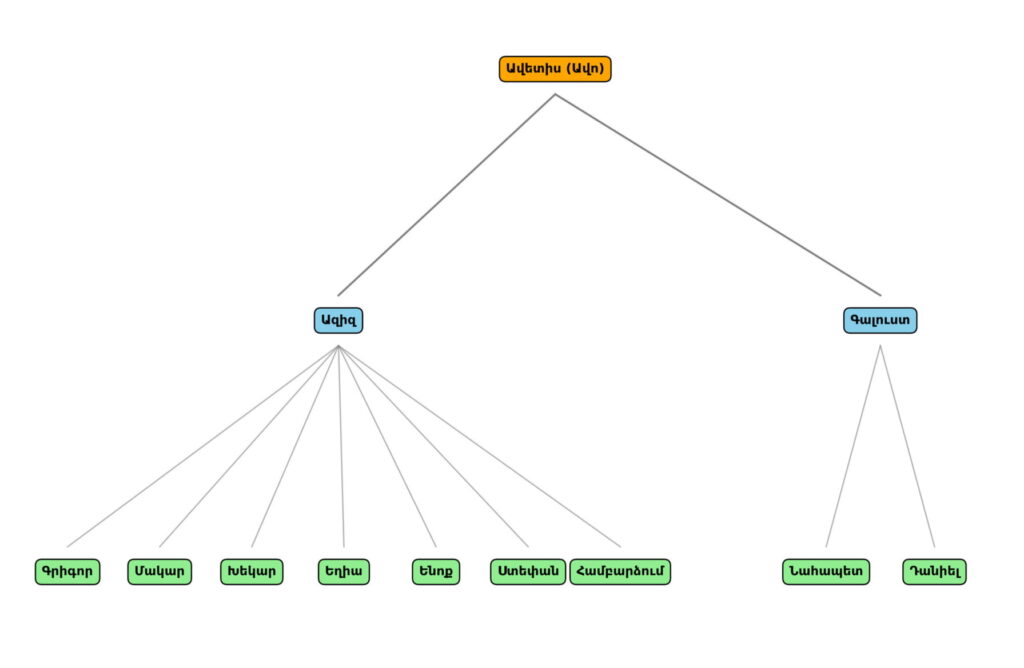
The lineage takes its name from the forefather Avetis (Avo). Avetis moved to Rind during the second quarter of the 19th century, during the years of the great migration following the 1828 Treaty of Turkmenchay. Archival data from the 1852 census reveals that Avetis’s patronymic was Martiros. At the time of the census, he was 43 years old (born in 1809). Avetis had two sons: Aziz (born in 1840) and Galust. The main branches of the lineage were formed through them.
Today, representatives of the Avoyents family bear four primary surnames:
- Avetisyan
- Azizyan
- Galstyan
- Makaryan (named after Aziz’s son, Makar)
Aziz’s sons were Grigor, Makar, Khekar, Yeghia, Enok, Stepan, and Hambardzum, while Galust’s sons were Nahapet and Daniel. Over time, the lineage expanded geographically; for instance, the descendants of Enok settled in Pokr Vedi, but the majority of the family continues to live and prosper in their native Rind.
Historically, the members of the Avoyents lineage were tillers of the land and builders. Alongside their labor, they were always ready to defend the homeland. The lineage had participants in the First and Second World War, the Artsakh Liberation War, and all subsequent self-defense battles. Even today, among the children of the family are high-ranking military officers holding responsible positions within the Armed Forces of the Republic of Armenia.
Thus, the history of the Avoyents lineage, originating from the heart of the Armenian Highlands, has strengthened and continued in Rind over the decades, remaining an inseparable and vital part of the village’s historical chronicle.