
 15°
15°  10 կմ/ժ


The final pages of the history of the First Republic of Armenia are filled with tragic yet heroic episodes. The events of April 1921, preserved through the memoirs of Zakar Yolyan (known by his pen name Z. Ashkhatuni), a member of the First Republic’s Parliament, reveal an odyssey where the region of Vayots Dzor, and specifically the village of Rind, played a crucial role in saving thousands of Armenian lives.
The Fall of Yerevan and the Great Exodus
April 2, 1921, remains a dark day in Armenian history. At 3:00 PM, Soviet troops entered Yerevan from the direction of Kanaker. An unprecedented chaos broke out in the city; panic gripped everyone as family members lost one another while desperately trying to flee.
The insurgent forces, under the command of the legendary Colonel Yaponi (Hovhannes Paronyan), were forced to retreat. They were followed by a massive crowd of approximately 12,000 to 15,000 people from Yerevan and surrounding villages. A significant part of Yerevan was emptied of its population, while the Red Army, upon entering the city, began its characteristic looting, plundering the property left behind by the retreating citizens.
Resistance for the Sake of Survival
Despite the dire situation, Armenian forces did not lay down their arms. The Armenian battalion of Kotayk launched a powerful counterattack, pushing the Red troops back to the walls of Yerevan. The situation was so tense that the communists remaining in the city had already packed their belongings, waiting for the order to flee. However, fate was cruel: the insurgents’ ammunition was so depleted that it could be counted on one’s fingers.
During a consultation held in Garni, a painful but inevitable decision was made: further resistance was impossible, especially since Tiflis (Tbilisi) had already fallen. It was decided to organize a systematic retreat toward Zangezur, where Garegin Nzhdeh had proclaimed the independence of the Republic of Mountainous Armenia.
The Road to Calvary: Snow, Hunger, and Despair
A superhuman journey began. Thousands of people—without bread, warm clothing, or proper footwear—had to cross snow-covered and inaccessible mountains in the freezing winter. Z. Ashkhatuni describes a state of terrible exhaustion and physical collapse. People were collapsing, being buried in the snow, and many perished along the way.
On the evening of April 11, after extreme suffering, the refugees reached the first settlement in Vayots Dzor—present-day Zangakatun (which was uninhabited at the time). There was no food and no way to get warm. The next day they reached Elpin, but even there, the locals were starving and lacked bread. Throughout the entire journey, the refugees survived only by eating various wild plants.
Rind: The Saving Haven
At 7:00 PM on the evening of April 12, when the last flickers of hope seemed to be fading, the crowd of refugees reached the villages of Rind and Aghavnadzor.
In his memoirs, Z. Ashkhatuni mentions with special warmth that it was here that the unfortunate refugees finally found both bread and rest. The people of Rind opened their doors to their retreating compatriots, sharing their hospitality and giving strength to the despondent people. It was a fateful moment when the village’s hospitality became the dividing line between life and death.
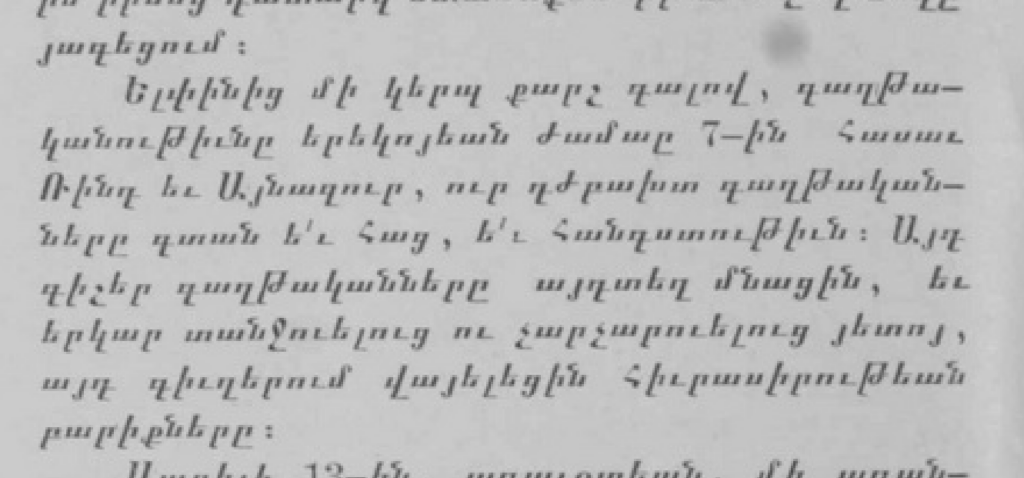
However, the respite was brief. The Red Army was in close pursuit, and the frontline had already reached the Rind-Aghavnadzor line. On April 13, the refugees continued their journey toward Getap and Yeghegnadzor, eventually passing through Malishka, Herher, and Gndevaz to enter Zangezur (Mountainous Armenia), escaping Soviet persecution.
The Heroic Spirit of Rind
This story serves as a testament to the significant role the village of Rind played during the critical final days of the First Republic of Armenia. The people of Rind not only supported the refugees with food and water but also fought with weapons against the Bolshevik gangs through their sons.
Among the pioneers of that struggle were Mher and Yenok, comrades-in-arms of General Andranik and Yaponi. Their bravery and dedication to the liberation struggle will be presented in our next publication.
Source: Hayrenik (Fatherland) Monthly, August 1925 issue, “Episodes from Our Struggle for Freedom.” Written by Z. Ashkhatuni.