


In the calendar of Rind village, May 1 is not just a red-letter day. It holds an exceptional significance and unique importance, perhaps comparable only to New Year’s in its scale and mass participation. For the people of Rind, this holiday is so deeply rooted in their daily lives and consciousness that in our childhood, many of us thought it was a compulsory holiday celebrated across all of Armenia, or even the whole world. The first great surprise comes when you realize that in some neighboring villages or cities, this day passes almost unnoticed, while in Rind, it is a true nationwide festivity.
Although May 1 emerged at the end of the 19th century as International Workers’ Day in memory of the Chicago workers’ demonstrations, it gained widespread popularity and became a mass celebration in Rind starting from the 1950s. The village elders testify that the holiday became particularly beloved and widely celebrated after the Second World War.
For the people of Rind, this is not a political or ideological holiday, but primarily a day honoring the Armenian peasant—the creator who earns a living through hard work and wrests their livelihood from the land. It feels like a unique ritual of taking a brief breath before active spring agricultural work, enjoying the awakening of nature, and strengthening community bonds.
May 1 in Rind is not just a one-day event. The spirit of the holiday is felt in the village starting from April 30, when the hustle and bustle of preparations and shopping begin, and concludes on May 2. It is celebrated by almost everyone, without exception, and each age group has its own format for celebrating.
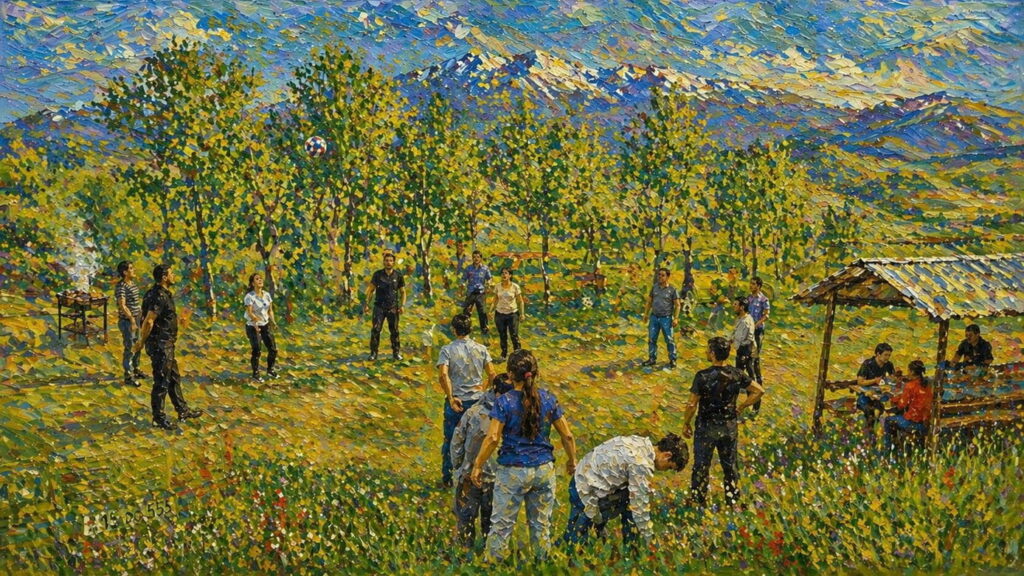
Family and Children’s Format: Young children celebrate the holiday with their families. On the morning of May 1, families head to the fields or mountains, spending the day in the lap of nature until evening. Games are organized, people enjoy the spring sun, and, of course, prepare the traditional barbecue (khorovats), which is an inseparable part of this day and is often served twice during the day.
School Friendships: Starting from the 5th-6th grade, the tradition changes. Children begin to celebrate the holiday not with their families, but with their classmates and peers. This tradition builds strong bonds of friendship that last for decades.
Youth: Among the youth, it is customary to head to the fields on April 30 itself. They spend the night in the fields around bonfires, greeting the May sunrise with songs and dances.
Traditional Places: From Old Rind to Our Days
Interestingly, over the years, groups of friends have acquired their favorite and permanent spots to celebrate the holiday, mainly located in the areas north and northeast of the village. Over time, many have built comfortable pavilions, created playgrounds, and planted and cared for trees in these very spots, turning them into true recreation areas for subsequent generations.
Looking back at history, it can be noted that the residents of Old Rind mainly celebrated the holiday in the northern areas adjacent to the village, especially in the abandoned village of Baghchajugh, where the festive paths of the residents of neighboring Aghavnadzor often crossed.
A Holiday that Knows No Boundaries or Age
The fact that May 1 in Rind is a state of mind and does not ask about age is evidenced by a touching scene from years ago. Two classmates, over 85 years old—Minasents Rafik and Baghdoyents Levon, whose other friends had already passed away—were seen coming out of the shop after making small purchases. They were preparing to sit under a tree and celebrate Workers’ Day together.
May 1 in Rind is not just a spring picnic. It is a holiday of respect for labor, friendship, connection with the land, and a beautiful tradition passed down from generation to generation.
